
How to Test Mission Critical Network Failover
Test mission critical network failover with clear recovery targets, realistic outage scenarios, independent monitoring and safe failback checks.
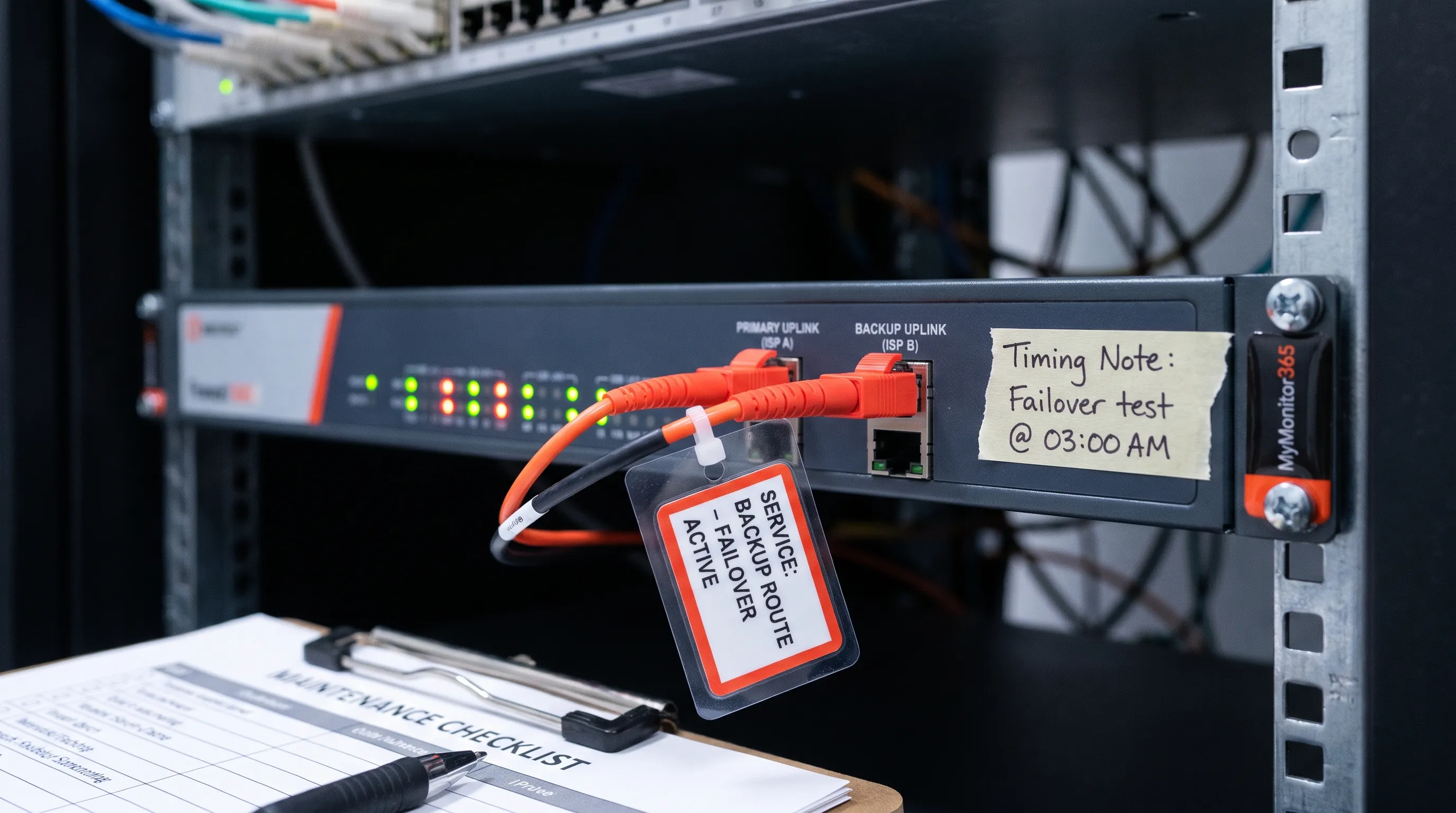
A mission critical network failover test must prove that essential services survive a failure, not merely that a backup interface comes up. Routes can converge while applications remain unavailable because of broken DNS, lost firewall state, asymmetric paths or an overloaded secondary connection.
The useful outcome is a repeatable record of what failed, when users lost service, how recovery happened and whether the fallback path remained secure. Test failback too: restoring the primary connection can cause a second interruption.
This runbook focuses on controlled, authorized exercises for enterprise IT and operations teams. For safety-related systems, coordinate with the responsible operational authority before introducing any fault.
1. Define service-level pass criteria
Start with the business transaction that must keep working. An interface, router or tunnel is a dependency, not the final measure of availability. Select representative workflows such as authenticating, retrieving an application record or completing an approved synthetic API transaction.
For a mission critical network, acceptance criteria should describe both the interruption and the quality of service after recovery.
| Dimension | What to define before testing |
|---|---|
| Service recovery | Maximum permitted interruption, aligned with the service recovery time objective |
| Application behavior | Whether established sessions must survive or reconnect within a defined limit |
| Backup performance | Acceptable latency, packet loss and transaction success under expected load |
| Security | Required segmentation, inspection, authentication and logging on the alternate path |
| Operations | Expected alert delivery, escalation and rollback behavior |
Make targets specific. An illustrative requirement might be recovery within 30 seconds followed by 20 consecutive successful synthetic transactions. Those numbers are examples, not universal recommendations, and a short sequence does not establish a long-term availability percentage.
Separate network convergence from service recovery. The first describes forwarding changes; the second describes when the application becomes usable. A test passes only when the agreed service criteria are met, not when the routing dashboard turns green.
2. Map and authorize the mission critical network test
Draw the complete primary and backup paths, including carriers, building entrances, power, edge devices, firewalls, VPN termination, DNS resolvers and application dependencies. Two circuits are not necessarily independent if they share a last-mile route, upstream equipment or power source. Record unverified assumptions rather than treating them as redundancy.
Set the blast radius and obtain change approval. Identify the test controller, device operator, application observer and person authorized to stop the exercise. Agree on explicit abort conditions, including impact to unrelated services, loss of management access or a security control failure.
Have a verified rollback procedure and configuration backups available. Keep an out-of-band management path and a communications channel that do not depend on the connection being disrupted. A backup contact list is insufficient if everyone reaches it through the affected network.
Use a lab or isolated segment first where practical. Progress to a limited production scope only after confirming the procedure and recovery access. NIST SP 800-34 Rev. 1 treats testing, training and exercises as part of contingency planning; a documented procedure should be exercised rather than assumed to work.
For clinical, utility or public safety environments, include the relevant operational owner in the go/no-go decision. Infrastructure approval alone may not cover the consequences of disrupted communications.
3. Establish independent observations and a baseline
Instrument the mission critical network from both sides of the potential failure. Internal device telemetry explains what changed, while application checks show whether the service remained usable. Neither view is sufficient alone.
Record normal behavior for representative traffic before injecting a fault. Include application response times, loss, jitter where relevant, interface utilization, routing state and firewall session behavior. Observe existing connections as well as newly initiated transactions.
Keep test observers independent of the failed component. A probe that disappears with the primary site cannot distinguish application failure from its own loss of connectivity. For public services, outside-in network monitoring can help distinguish a local access problem from wider unavailability. Private services need authorized observation points with access to the relevant path.
Synchronize clocks and record timestamp resolution. Choose a sampling interval that can resolve your recovery target. One-minute checks cannot validate a five-second interruption limit. Sampled checks also leave uncertainty between observations, so use higher-frequency test traffic or packet captures when tighter measurement is necessary.
MyMonitor365 supports HTTP/API, ping/ICMP and TCP checks, along with SSL security, DNS change monitoring, multi-location monitoring and alert integrations. Pair these signals with device telemetry and application-level test traffic. External checks alone cannot prove routing correctness, session preservation or internal segmentation.
4. Run the first controlled failover
Begin the mission critical network exercise with one documented fault and a deliberately limited scope. A planned interface shutdown is a useful starting point, but it does not represent every real outage.
- Confirm readiness: Verify baseline health, approval, observer coverage, rollback access and the stop conditions. Confirm that the backup path is available before proceeding.
- Start representative traffic: Maintain established sessions while generating new connections and approved synthetic transactions. Include dependencies such as authentication and DNS where they are part of the workflow.
- Inject the agreed fault: Have the authorized operator perform the approved action. Record the action and timestamp without making unrelated configuration changes.
- Observe recovery: Capture the first failed transaction, fault detection, route or tunnel changes, alert receipt and sustained application recovery. Confirm that traffic actually traverses the intended backup path.
- Hold and assess: Keep the service on backup long enough to assess stability and the planned workload, unless an abort condition requires immediate rollback.
Do not declare success after one good ping. A reachable gateway does not prove that a user can authenticate or complete a transaction. Likewise, successful retries can conceal a meaningful interruption, so record failed attempts and retry delays rather than reporting only eventual success.
If unexpected behavior appears, preserve the available evidence, then follow the agreed stop or rollback procedure. Avoid improvising several changes that make the original failure impossible to explain.
5. Test failures that leave the interface up
A mission critical network can lose useful connectivity without losing electrical link state. After the basic exercise passes, test additional failure modes separately so the cause of each result remains clear.
| Scenario | What the exercise should reveal |
|---|---|
| Upstream blackhole with local link up | Whether path-health detection recognizes loss beyond the next hop |
| One-way loss or asymmetric routing | Whether return traffic, stateful inspection and application sessions still work |
| Degraded primary path | Whether latency or loss triggers the intended policy without unstable switching |
| DNS or authentication dependency unavailable | Whether the alternate path reaches required supporting services |
| Edge device or power-domain failure | Whether redundancy extends beyond the carrier circuit |
Use approved fault-injection methods in an isolated environment before attempting higher-risk production scenarios. Do not simulate an upstream failure by disrupting infrastructure outside your authority.
Check the exact object that health probes test. A gateway can respond while the application path beyond it is unusable. Conversely, a failed probe target can trigger unnecessary failover even when user traffic remains healthy. Test targets and thresholds should reflect the failure the mechanism is intended to detect.
Evaluate failures individually before combining them. A carrier outage followed by a device reboot may be a useful later exercise, but introducing both together makes diagnosis harder and increases risk. Record which scenarios remain untested rather than describing a single successful switchover as complete resilience validation.
6. Validate backup capacity and security
Once basic recovery works, evaluate whether the alternate connection can sustain the intended workload without changing the service’s required security controls.
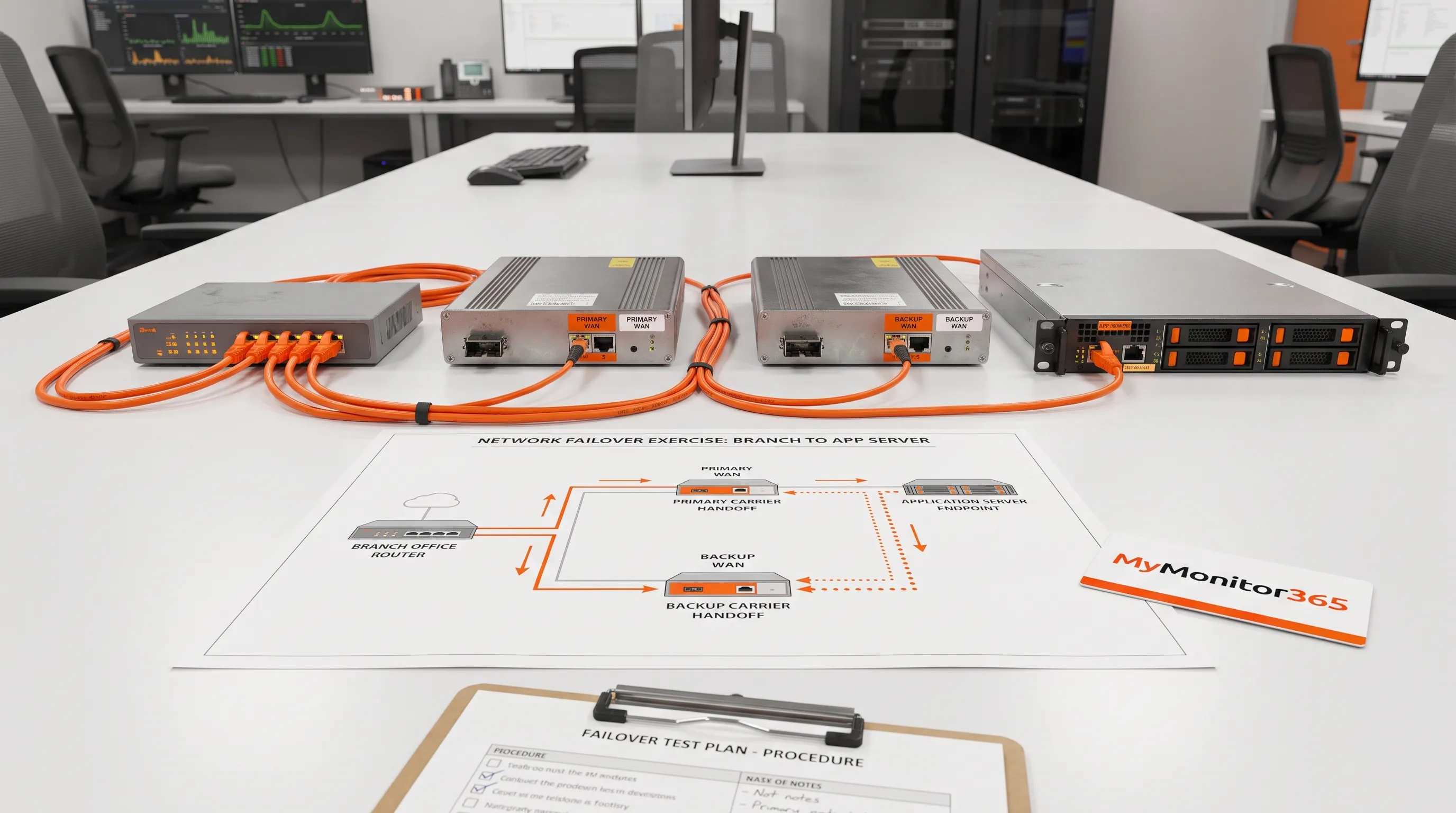
Use an approved workload profile that represents expected demand during an outage. Include concurrent sessions, upload and download traffic, connection establishment and latency-sensitive applications where relevant. Increase load in controlled stages and stop at the agreed limits; do not turn a failover exercise into an uncontrolled saturation test.
Verify prioritization under contention. If the backup cannot carry everything, confirm that essential services retain usable capacity while lower-priority traffic is constrained according to policy. A lightly loaded overnight test does not establish daytime capacity.
Check for alternate-path differences such as changed public IP addresses, provider filtering, tunnel overhead, MTU behavior or address translation. Cellular and satellite backups may have different constraints from the primary connection, so validate actual application behavior rather than assuming equivalence.
Finally, verify segmentation, firewall policy, VPN protection, authentication and required logging. A fallback route that restores availability by bypassing mandatory controls is a failed test. Document any approved reduced-service mode explicitly, including who can authorize it and how long it may remain active.
7. Test failback as a separate operation
Returning a mission critical network to its primary path deserves its own acceptance criteria. A connection becoming reachable does not necessarily mean it is stable or ready to carry production traffic.
Confirm how your design handles restoration: automatic preemption, a stability hold-down or operator-controlled failback. Follow the documented policy rather than changing it during the exercise. Observe the primary path long enough to satisfy the agreed health conditions before moving traffic back.
Repeat the application checks used during failover. Watch established sessions, new connections, public source addresses, NAT behavior, routing symmetry and firewall state. Existing flows may stay on the backup while new flows move to the primary, depending on the design. Record that behavior and decide whether it meets the service requirement.
In an appropriately isolated test, evaluate a primary path that repeatedly loses and regains health. Confirm that the design does not oscillate between links and create repeated user interruptions. Avoid this scenario in production unless its risk and controls have been explicitly approved.
After restoration, verify that the backup is still available, temporary changes have been removed and monitoring has returned to its intended state. Keep the exercise open until both the primary service and the standby capability are confirmed healthy. Restoration of the preferred route alone is not the end of the test.
8. Produce evidence and retest failed criteria
The output of a mission critical network exercise should be an evidence-backed result, not a general statement that redundancy works. Report each scenario separately, including incomplete tests and observations that could not be verified.
Build a timeline with the fault-injection time, first observed service failure, detection, alert receipt, forwarding changes, sustained recovery and failback. Distinguish direct observations from estimates. For example, the first failed sampled check is not necessarily the exact moment the outage began.
Retain relevant application results, routing events, interface statistics, firewall logs and carefully scoped packet captures. Protect credentials, customer information and other sensitive data in the evidence. Consistent timestamps and structured network event logging make cross-system correlation easier.
For every unmet criterion, record the observed behavior, operational impact, corrective action, owner and retest requirement. A configuration change is not proof that the problem is fixed. Repeat the failed scenario using the same acceptance criteria, then check for regressions in related scenarios.
Retest after material changes to routing, carriers, firewalls, VPNs, DNS, application dependencies or backup capacity. Set the recurring exercise schedule according to service risk and organizational obligations, not an arbitrary universal interval.
The final report should state precisely what was proven, under what workload and with which limitations. Untested shared dependencies remain risks even when every executed scenario passes.
Frequently asked questions
How often should you test mission critical network failover? Set a recurring schedule based on business impact, change rate and applicable obligations. Also test after material dependency or configuration changes. A previous pass does not validate a different topology, carrier or application workload.
Does a successful ping prove failover worked? No. Ping demonstrates ICMP reachability from one observation point. Validate the required application transactions, supporting dependencies, established sessions, new connections and security controls across the alternate path.
Should alerts be suppressed during the exercise? Coordinate expected notifications, but preserve an explicitly planned alert-delivery test. Maintenance windows or suppression rules must not hide whether detection, delivery and escalation work. Record any temporary exceptions and remove them afterward.
Can failover testing be performed without downtime? Some exercises may produce no visible interruption, but do not promise zero downtime before testing. Use staged scope, approved synthetic traffic and rollback controls. Production testing requires acceptance of the remaining risk by the responsible owner.
Is automatic failback always better? No. Automatic restoration can reduce operator effort, but an unstable primary path can cause repeated switching. Choose restoration behavior based on application tolerance, path stability and operational requirements, then test that behavior explicitly.
Put monitoring around the next exercise
Before the next mission critical network test, define the transactions, observation points, timing resolution and alert destinations needed to judge recovery objectively.
Explore MyMonitor365 for uptime, HTTP/API, TCP, DNS and SSL monitoring with multi-location checks and alert integrations. A free plan is available with no credit card required. Combine service observations with your device telemetry and approved test procedure to verify recovery, failback and the limits of the backup design.
#ITOps #NetworkFailover #NetworkResilience #Uptime #DisasterRecovery