
Networking in IT Infrastructure for Reliable Services
Make networking in IT infrastructure more reliable with clear components, resilient design choices and practical service-level checks.
Reliable networking in IT infrastructure means more than keeping switches powered on and links connected. It means giving applications a predictable path to users, identity services, databases and external providers, even when equipment fails or configurations change. A server can be healthy while the service it supports remains unreachable.
For IT managers and network teams, the useful starting point is the business service, not the device inventory. Which connections must work for a customer to complete a transaction or an employee to sign in? Answering that question connects network design, capacity planning and monitoring to outcomes the organization actually needs.
What the network contributes to a working service
Networking connects the physical and virtual parts of an IT environment so they can exchange data. IT infrastructure is broader: it also includes compute, storage, operating systems and the facilities or cloud resources that support them.
Consider an employee opening a hosted business application. The device needs connectivity, a DNS answer and a valid route to the destination. Traffic may pass through wireless infrastructure, a firewall, an internet connection and a cloud load balancer before reaching the application. Authentication can introduce another dependency on an identity provider.
Each dependency can fail independently. A working internet connection does not prove that DNS resolution succeeds. An open application port does not prove that login works. Successful access from headquarters does not establish that branch offices have the same experience.
Service reliability depends on the complete connection path, not the health of one component. Documenting that path makes it easier to identify shared dependencies, choose meaningful tests and assign responsibility before an outage occurs.
Seven components of networking in IT infrastructure
There is no single mandatory list of seven network components. For architecture and operations reviews, the following grouping is useful because it covers both the equipment and the services required to move traffic reliably.
| Component | Role in the service path | Reliability question |
|---|---|---|
| Endpoints and interfaces | Connect user devices, servers, appliances and virtual workloads to networks | Are interfaces correctly configured and supported at the required speed? |
| Transmission media | Carry traffic over copper, fiber, wireless or provider circuits | Can physical damage, interference or shared routing interrupt connectivity? |
| Switching and local access | Connect devices within local network segments | Could a failed switch, uplink or wireless controller disconnect a critical group? |
| Routing and wide-area connectivity | Move traffic between subnets, sites, cloud networks and external destinations | Are alternate routes available and tested? |
| Addressing and naming services | Provide IP addressing and name resolution through services such as DHCP and DNS | Can workloads obtain addresses and resolve dependencies during a failure? |
| Security enforcement | Apply firewall rules, segmentation, access policies and secure tunnels | Do permitted application flows work without granting unnecessary access? |
| Control and management systems | Maintain configurations, routing policies, management access and operational visibility | Can teams still operate and recover the network when a management dependency fails? |
These categories overlap. A firewall may route traffic, while a cloud platform may provide virtual switching and DNS. The operational requirement is to identify the function, its dependencies and its owner, regardless of which product delivers it.
Design for failures, not just normal traffic
Make redundant paths genuinely independent
Two connections are not necessarily two independent paths. Separate circuits may share a building entrance, cable duct, upstream carrier or power source. Two virtual appliances may still depend on the same host or availability zone.
For networking in IT infrastructure, redundancy is useful only when the surviving path can carry the required service traffic. Check physical diversity, routing behavior and available capacity rather than counting interfaces.
Failover also needs to preserve acceptable application behavior. A backup link might restore reachability while established sessions drop because firewall or NAT state is not shared. That may be acceptable for a reporting application but disruptive for voice calls or active transactions.
Record the expected outcome for each failure: how long recovery should take, whether users must reconnect and which services receive priority if backup capacity is limited.
Limit failure spread with segmentation
Segmentation separates traffic and policy boundaries so that one problem has fewer opportunities to affect unrelated systems. Typical boundaries include employee devices, production applications, management interfaces and guest access.
The design should reflect actual application communication. A VLAN creates a logical separation, but access controls are still needed to enforce which traffic can cross that boundary. Overly broad firewall rules weaken isolation, while incomplete rules can break legitimate dependencies.
Keep management access recoverable without making it universally accessible. Where justified by service criticality, an independent recovery path can help operators repair routing or firewall mistakes that would otherwise lock them out.
Account for hybrid and cloud dependencies
Cloud networking changes where infrastructure runs, not whether network dependencies exist. Virtual routes, security groups, VPN tunnels, private connections and cloud DNS zones all influence service availability.
Reliable networking in IT infrastructure requires checking both sides of a hybrid connection. The on-premises route may be correct while the cloud return route is missing. A tunnel may be established while the intended application traffic is blocked.
Naming deserves particular attention. Split DNS can return different addresses to internal and external clients, creating different service paths. DNS caching can also delay the effect of record changes; the IETF's DNS specification describes the role of time-to-live values in cached data.
Document where names resolve, which routes traffic follows and which team controls each boundary. This is especially important when internal teams, MSPs and cloud providers share responsibility.
Set reliability targets at the service level
Device availability is useful operational information, but it is not a complete service objective. Define success in terms of what a user or application must accomplish.
A service-level indicator, or SLI, measures a specific behavior. Examples include successful HTTPS requests or the proportion of scheduled connection tests that succeed. A service-level objective, or SLO, sets the target for that indicator. An SLA is a service agreement that may include contractual commitments and remedies.
For a time-based SLO measured continuously over a 30-day month, 99.9% availability allows 43.2 minutes of downtime. That calculation alone does not define how to treat partial failures, maintenance or unavailable measurement data. Those rules must be explicit.
When evaluating networking in IT infrastructure, pair availability with service-relevant performance measures. Latency and packet loss can affect interactive applications, while jitter is particularly relevant to real-time media. Track tail latency, such as the 95th percentile, when averages hide slow experiences.
The guide to network availability metrics IT leaders should track can help connect technical measurements to reporting expectations. Establish the measurement method before comparing results across teams or providers.
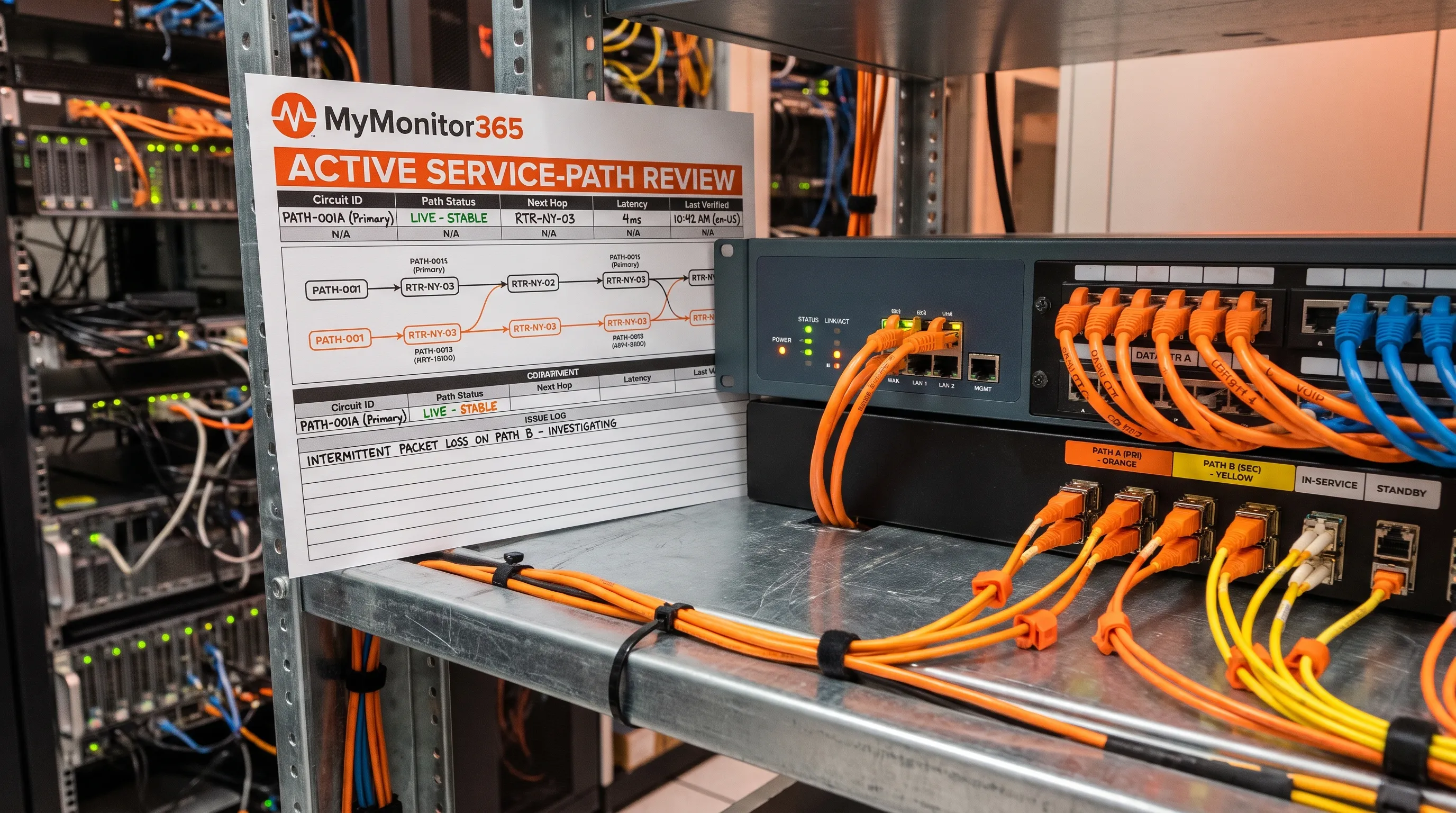
Validate the architecture with a service-path review
A service-path review tests whether the documented design matches real behavior. Start with one important service rather than attempting to validate the entire estate at once.
Trace dependencies from the user's location
Record the user population, destination hostname, DNS resolver, network boundaries and application entry point. Include identity services and external APIs when they are required for the workflow.
Then compare expected behavior across representative locations. An office user, a remote employee and a cloud-hosted integration may reach the same application through different routes and policies.
Use this sequence to organize the review:
- Define success: Specify the request or workflow that proves the service is usable, including acceptable response time.
- Trace the path: Record naming, connectivity, security boundaries and application dependencies.
- Identify shared risks: Look for common power, carriers, controllers, identity systems and management dependencies.
- Test controlled failures: Validate agreed scenarios through approved change procedures with rollback plans.
- Record the evidence: Capture recovery behavior, remaining capacity, user impact and the responsible owner.
This turns networking in IT infrastructure into a testable service design rather than a diagram that only describes normal operation.
Test degraded operation, not just total failure
Suppose two offices access an application through a primary internet circuit and a backup connection. Disconnecting the primary circuit may demonstrate that routing switches correctly. It does not establish that the backup can support a busy workday.
Test representative traffic on the backup path and observe latency, loss and application behavior. Confirm that DNS and authentication remain reachable. Check whether security policies differ between connections and whether long-lived sessions survive or reconnect successfully.
Include partial failures in the test plan. Packet loss, an incorrect route or a blocked application port can be more difficult to detect than a disconnected link. Packet-size problems can also affect some transactions while smaller requests continue to work.
Run disruptive tests only with authorization, a defined scope and a recovery plan. If a production test is not acceptable, document the limitation and validate as much as possible in a representative environment. An untested assumption should remain visible as a risk, not become an implied guarantee.
Use monitoring to verify the design continuously
Architecture reviews establish expectations; monitoring checks whether those expectations remain true. For networking in IT infrastructure, the most useful signals distinguish basic connectivity from application usability.
ICMP checks can test reachability when the destination permits them. TCP checks establish whether a connection can be made to a particular port. HTTP checks go further by testing an application response, with content checks helping identify pages that return a successful status but unexpected content.
These checks are complementary. The TCP standard defines transport behavior, not whether an application completed a business operation. Likewise, an HTTP response cannot prove that every dependent workflow works.
Choose observation points that represent relevant users and dependencies. Public checks cannot automatically validate private network paths, so confirm how each target will be reached. Combine service checks with appropriate device telemetry, traffic information and configuration records where deeper visibility is needed.
For a detailed coverage approach, see how to monitor network infrastructure without blind spots. Keep the architecture review focused on what must work and use monitoring to verify those requirements over time.
Give each critical path an accountable owner
A technically accurate alert can still lead to a slow response if no one owns the affected dependency. Record a primary owner and escalation contact for each critical service boundary, including provider-managed connections.
Agree on what evidence an escalation needs: affected locations, destination, failure type, timestamps and recent changes. This reduces repeated handoffs between application, network and cloud teams.
Review ownership whenever a service moves, an MSP contract changes or a new provider enters the path. A stale contact list is an operational dependency too.
Frequently asked questions
What are the seven steps of networking? There is no universal seven-step networking process. The phrase often refers to the seven layers of the OSI model: physical, data link, network, transport, session, presentation and application. These are conceptual layers, not chronological troubleshooting steps. They help organize questions about connectivity and protocols, but operational investigations should follow the affected service and available evidence.
What are the three tiers of internet service providers? In the common classification, Tier 1 networks reach the internet through settlement-free peering without purchasing transit. Tier 2 networks combine peering with purchased transit. Tier 3 providers generally purchase upstream transit to serve customers. These labels do not, by themselves, establish service quality or path independence. Evaluate actual routes, capacity, support commitments and shared infrastructure.
Does a successful ping mean an application is available? No. Ping tests an ICMP exchange, not the application's TCP listener, TLS configuration or business workflow. Effective networking in IT infrastructure needs checks aligned with the service being delivered. Conversely, a failed ping does not necessarily indicate an outage because firewalls or destinations may intentionally block ICMP.
Put one critical service under review
Choose a service with clear business impact. Document its connection path, identify shared failure points and verify one approved failover scenario. Assign an owner to every unresolved dependency before expanding the review to additional services.
MyMonitor365 supports HTTP/API monitoring, ping and ICMP checks, TCP port monitoring, SSL security monitoring, DNS change monitoring and multi-location monitoring. Maintenance windows and alert integrations help teams align checks with operational workflows. A free plan is available with no credit card required.
Use monitoring evidence to confirm that the paths you designed remain available, while retaining separate validation for workflows that basic checks cannot prove.
#ITOps #NetworkInfrastructure #ServiceReliability #NetworkMonitoring