
What to Look for in Network Monitoring Managed Services
Choose network monitoring managed services with better coverage, alerts, SLAs, security checks, and MSP-ready reporting for reliable uptime.
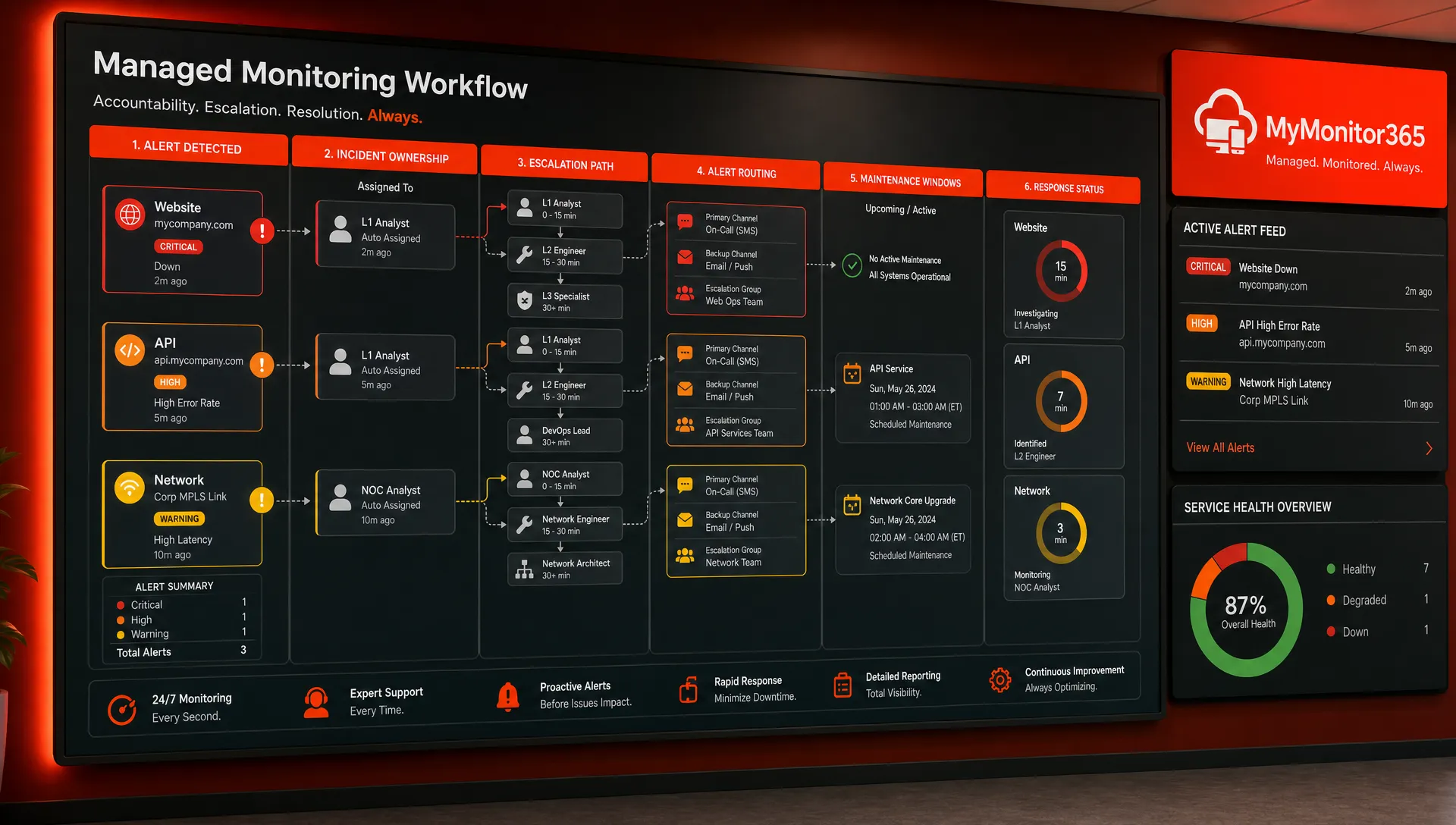
Network monitoring managed services are usually considered after a painful outage, a near miss, or a realization that the internal IT team is spending too much time watching tools instead of improving systems. The right provider can reduce detection time, improve escalation, and give leadership more confidence in availability. The wrong provider simply adds another dashboard and more alerts.
For IT managers, network teams, CIOs, and IT operations leaders, the goal is not to outsource responsibility. It is to extend operational visibility, add reliable coverage, and make incidents easier to understand and resolve. Here is what to look for when evaluating network monitoring managed services for an MSP relationship or a managed monitoring partner.
The best managed monitoring service is an operating model, not just a tool
A monitoring platform can test endpoints, collect signals, and send alerts. A managed service should go further. It should define what matters, how incidents are handled, who is accountable, and how the environment improves over time.
That distinction matters because outages rarely come from a single obvious failure. A customer portal might be reachable over ping while the application returns errors. A server might be healthy while DNS points users to the wrong location. An SSL certificate might renew on one domain but fail on another. A firewall change might leave a critical TCP port closed even though the device itself is online.
Strong network monitoring managed services combine technical coverage with operational discipline. They help teams answer three questions quickly: What is failing, who is affected, and what should happen next?
1. Monitoring coverage should match how services actually fail
A common mistake is evaluating managed monitoring by asking how many devices it can watch. Device count matters, but service reliability depends on layers. A provider that only monitors ping can miss serious application, DNS, SSL, and port-level failures.
A good managed service should support layered checks across the infrastructure stack, including public websites, APIs, DNS, certificates, network paths, and critical ports. For MSPs, this is especially important because each client environment may have different critical dependencies.
| Monitoring layer | What the provider should watch | Common problems it exposes |
|---|---|---|
| Ping and ICMP | Basic reachability and packet loss | Offline hosts, routing issues, degraded connectivity |
| TCP ports | Whether specific services accept connections | Closed ports, firewall changes, stopped services |
| HTTP and API | Status codes, response time, expected content | Application outages, bad deployments, broken endpoints |
| SSL and TLS | Expiration, validity, certificate chain health | Failed renewals, invalid certificates, trust issues |
| DNS | Record changes and resolution behavior | Incorrect updates, propagation issues, hijacked or stale records |
| Keyword content checks | Expected text or page content | Wrong pages, content replacement, defacement indicators |
| Multi-location checks | Availability from different regions | Regional ISP, CDN, routing, or DNS problems |
If you are building an evaluation checklist, the MyMonitor365 guide on monitoring your full infrastructure stack is a useful reference for thinking beyond basic uptime checks.
2. The service must reflect business criticality
Not every system deserves the same alert path. A test server going offline at midnight should not trigger the same response as a customer payment API failing during business hours. Network monitoring managed services should help you classify assets by impact, not just by technical category.
Start by grouping monitored services into practical tiers. Mission critical services typically include customer-facing applications, authentication systems, VPN or remote access, payment systems, DNS, email gateways, and core network paths. Important but less urgent services might include internal applications, staging systems, noncritical reporting tools, or secondary endpoints.
This classification should influence check frequency, alert severity, escalation rules, notification channels, and reporting. It should also shape maintenance windows. If a provider cannot explain how they distinguish a business-critical outage from a low-impact warning, you may end up with either missed incidents or constant noise.
3. Multi-location visibility is essential for distributed operations
A single monitoring location can be misleading. If a check fails from one region, the issue might be with the monitored service, the monitoring probe, an ISP route, a CDN edge, or a local DNS resolver. Multi-location monitoring helps separate a true outage from a regional or path-specific problem.
For modern IT environments, this matters more than ever. Users may connect from headquarters, branch offices, home networks, mobile providers, cloud regions, or overseas locations. Cloud adoption has also changed the meaning of local availability. A service can be healthy in one region and degraded in another.
This is especially relevant when operations depend on regional connectivity or local support knowledge. For example, organizations working across Caribbean and Guiana markets may value providers specifically in their region because regional expertise, support availability, and cloud proximity can affect how incidents are understood and resolved.
When evaluating a provider, ask how many locations are used for checks, where they are located, and how regional failures are represented in alerts. The answer should help your team quickly determine whether an issue is global, regional, provider-specific, or customer-specific.
4. Alert quality matters more than alert volume
More alerts do not mean better monitoring. In many environments, too many alerts make teams slower. Engineers begin to ignore notifications, important incidents are buried, and leadership loses confidence in the monitoring process.
High-quality alerts should be actionable. They should identify the affected service, the failing check, the location of the failure, the severity, recent changes if known, and the next expected response. They should also avoid alerting multiple teams for the same root cause when one upstream dependency is responsible.
A provider should be able to explain how it handles:
Severity levels and escalation paths
Maintenance windows and planned downtime
Duplicate or flapping alerts
Dependency-related alert storms
Alert routing by client, service, team, or impact
Acknowledgement and ownership tracking
Alert noise is one of the most common reasons monitoring programs lose credibility. If this is a current pain point, MyMonitor365 has a practical article on how managed service providers reduce alert noise, many of the same principles apply to network operations.
5. Response expectations should be explicit before contract signature
A managed monitoring provider should not leave incident response assumptions vague. Before choosing a partner, clarify what happens when an alert fires. Some providers only notify your team. Others investigate, escalate, open tickets, contact carriers, or take preapproved remediation steps. None of these models is automatically right or wrong, but ambiguity is risky.
Use the evaluation process to define response ownership in plain language.
| Question to ask | What a strong answer should clarify |
|---|---|
| Who receives the first alert? | Named teams, roles, channels, and escalation order |
| How fast is acknowledgement expected? | Response expectations by severity and support window |
| What can the provider do without approval? | Preauthorized troubleshooting or remediation actions |
| How are customers or internal stakeholders updated? | Communication cadence, status updates, and ownership |
| How is planned maintenance handled? | Maintenance windows, suppression rules, and audit trail |
| What happens after a major incident? | Timeline, root cause summary, lessons learned, and action items |
For CIOs and IT managers, this is where service-level language matters. Do not only review uptime targets. Review acknowledgement times, escalation rules, reporting obligations, and exclusions. A provider that promises monitoring but cannot describe the operating process may not be ready to protect critical services.
6. Security-related signals should not be treated as a separate universe
Network monitoring is not the same as a SIEM or full security operations program, but availability and security signals often overlap. DNS changes, unexpected certificate problems, open or closed ports, and unusual website content can all point to operational mistakes or possible compromise.
A security-minded managed monitoring service should pay attention to these signals without confusing every warning for a breach. For example, an expired certificate may be a process failure, but a certificate mismatch can also indicate misconfiguration or traffic being routed somewhere unexpected. A DNS record change might be planned, but it can also break access or reveal unauthorized updates.
Access control also matters. Look for two-factor authentication, audit logs, role-based access where available, and clear processes for onboarding and removing users. Monitoring systems hold sensitive operational information, so they should be protected like any other critical IT system.
7. Reporting has to prove value to both IT and leadership
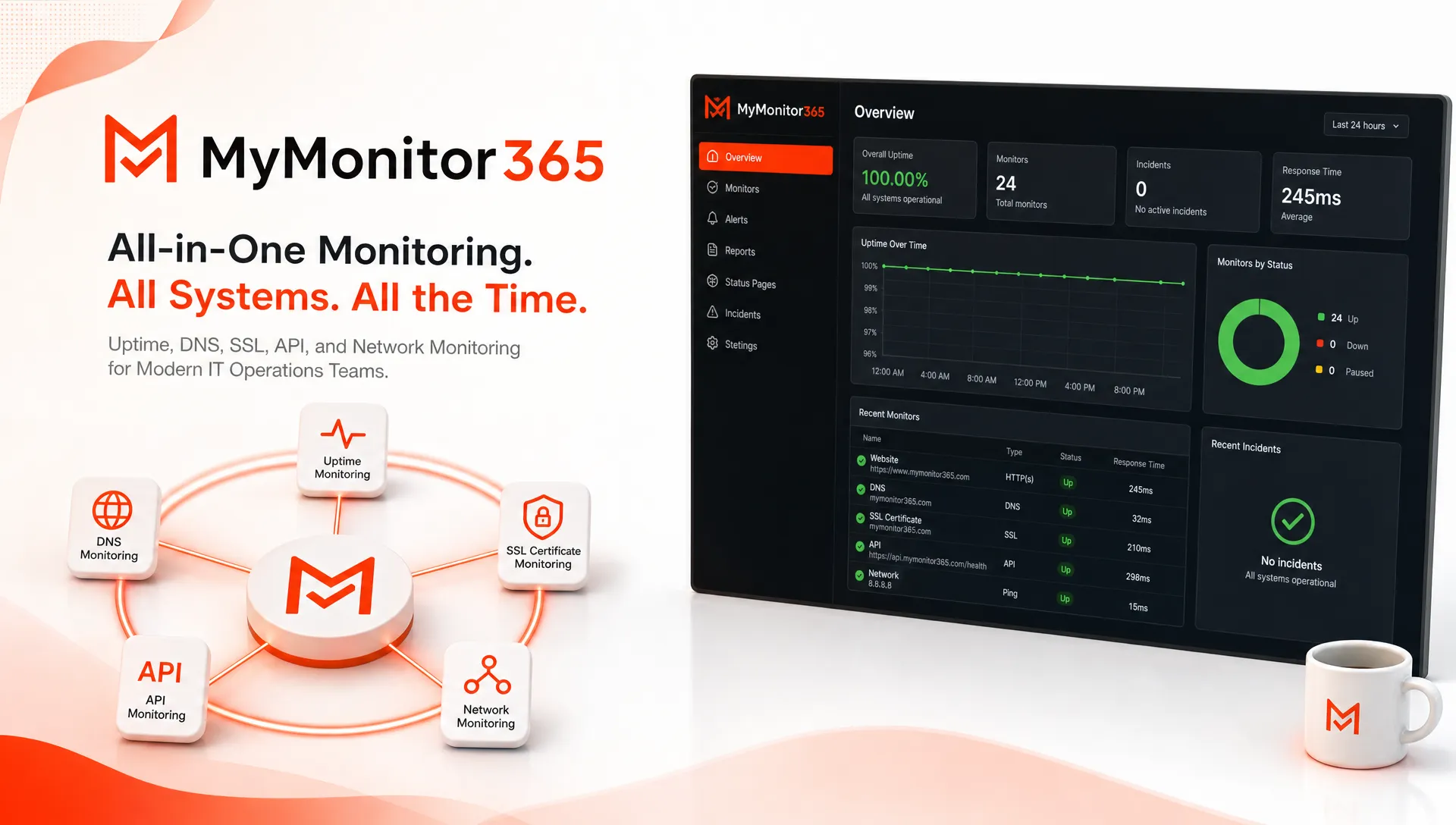
Managed monitoring should produce more than incident notifications. It should create a reliable record of service health, recurring issues, response activity, and improvement opportunities.
Different stakeholders need different reporting views. Network engineers need technical detail. IT managers need trend and accountability data. CIOs need risk, business impact, and investment signals. MSPs need client-ready evidence that their service is working.
| Audience | Useful reporting evidence |
|---|---|
| Network and operations teams | Recent incidents, failed checks, latency patterns, affected services |
| IT managers | Availability trends, recurring problem areas, response performance |
| CIOs and business leaders | Risk reduction, service reliability, major incident summaries |
| MSP account teams | Client summaries, maintenance records, SLA evidence, follow-up actions |
The best reports are not just monthly PDFs that nobody reads. They help teams make decisions. If DNS problems recur, the provider should flag that pattern. If SSL renewals repeatedly create risk, the process should change. If a specific site has frequent regional failures, the network path or hosting design may need review.
8. Integration with existing workflows determines daily adoption
Even a strong monitoring service can fail if it does not fit how your teams work. Alerts should reach the channels your engineers actually use. Incident context should be clear enough to act on without logging into three different systems. Maintenance windows should be easy to apply and review.
When assessing network monitoring managed services, ask how alerts integrate with collaboration tools, ticketing workflows, and on-call processes. Also ask whether alert messages can include the service name, check type, affected region, severity, timestamps, and links to relevant context.
Operational fit is often the difference between a tool that gets adopted and one that becomes shelfware. If the provider forces your team to change every workflow to match their system, the transition may create friction. If they can adapt alerts and responsibilities to your operating model, the service is more likely to succeed.
9. Vendor transparency and commercial model need scrutiny
Before signing, make sure you understand what is included and what costs extra. Managed monitoring pricing can vary based on monitored assets, check frequency, number of locations, notification volume, integrations, users, retention, support hours, or remediation scope.
You do not need the cheapest provider. You need a model that is predictable and aligned with the value of the services being protected. Ask what happens when you add new endpoints, onboard a new client, increase check frequency, or require additional notification channels.
Transparency should also apply to limitations. Every monitoring service has boundaries. A trustworthy provider will clearly explain what they detect, what they do not detect, when humans are involved, and where your team remains responsible.
Red flags when evaluating network monitoring managed services
Some warning signs appear early in the sales process. Pay attention to them because they often become operational problems later.
The provider focuses only on device count and does not discuss business impact.
Monitoring relies on a single location with no regional verification.
Every alert is treated as high priority.
Maintenance windows are manual, unclear, or not audited.
SSL, DNS, API, and TCP checks are missing or treated as optional extras.
There is no documented escalation process.
Reports show uptime percentages but no useful incident context.
Access controls and audit logs are not discussed.
The provider cannot explain what happens during and after a major incident.
A strong provider should welcome these questions. If the answers are vague, the service may not be mature enough for critical environments.
Where MyMonitor365 fits into your managed monitoring model
MyMonitor365 is built for teams that need visibility across uptime, performance, and security-related infrastructure signals. It supports HTTP and API monitoring, ping and ICMP checks, TCP port monitoring, SSL security monitoring, DNS change monitoring, keyword content checks, multi-location monitoring, maintenance windows, two-factor authentication, audit logs, and alert integrations.
For internal IT operations teams, this can provide a practical monitoring layer across websites, servers, network services, certificates, and DNS. For MSPs, it can support client-focused monitoring models where fast detection, clear alerts, and consistent service checks are essential.
The key is to pair the platform with a clear operating process. Define critical services, assign owners, tune alert severity, document escalation paths, and review incidents regularly. Monitoring creates the signal. Operational discipline turns that signal into reliability.
Frequently Asked Questions
What are network monitoring managed services? Network monitoring managed services combine monitoring tools, alert handling, reporting, and operational support to help organizations detect and respond to network, service, DNS, SSL, and application availability problems.
How are managed services different from buying a monitoring tool? A tool collects checks and sends alerts. A managed service should add process, escalation, expertise, reporting, and accountability. The best model often combines a strong platform with clear human workflows.
Which checks should be included in a managed monitoring service? At minimum, look for ping or ICMP, TCP port checks, HTTP and API monitoring, SSL certificate monitoring, DNS monitoring, multi-location checks, and maintenance window support. Keyword content checks are also useful for detecting wrong or unexpected pages.
How should I evaluate an MSP's monitoring SLA? Review more than uptime promises. Ask about alert acknowledgement time, escalation paths, support hours, communication cadence, reporting, exclusions, and post-incident review. Make sure responsibilities are documented before an incident occurs.
Can managed monitoring cover cloud, on-premises, and hybrid environments? Yes, if the provider supports checks across public endpoints, network services, DNS, SSL, APIs, and critical ports. Hybrid environments often need layered monitoring because failures can occur in cloud services, local networks, identity systems, or external dependencies.
How does MyMonitor365 help MSPs and IT operations teams? MyMonitor365 provides monitoring across HTTP and APIs, ping and ICMP, TCP ports, SSL, DNS changes, keyword content, and multiple locations, with alert integrations, maintenance windows, audit logs, and two-factor authentication.
Build a monitoring model your team can trust
Choosing network monitoring managed services is ultimately about reducing uncertainty. You want faster detection, clearer alerts, better escalation, and evidence that critical services are being watched from the right angles.
If you are ready to strengthen uptime and infrastructure visibility, explore MyMonitor365 and start building a monitoring approach that fits your team, your clients, and your most important services. A free plan is available with no credit card required.
Suggested hashtags: #MSP #Monitoring #NetworkMonitoring #ITOperations #UptimeMonitoring #ManagedServices