
How Security and Infrastructure Teams Can Share Alerts
Learn how security and infrastructure teams can share alerts, reduce noise, assign ownership and speed up incident response across IT operations.
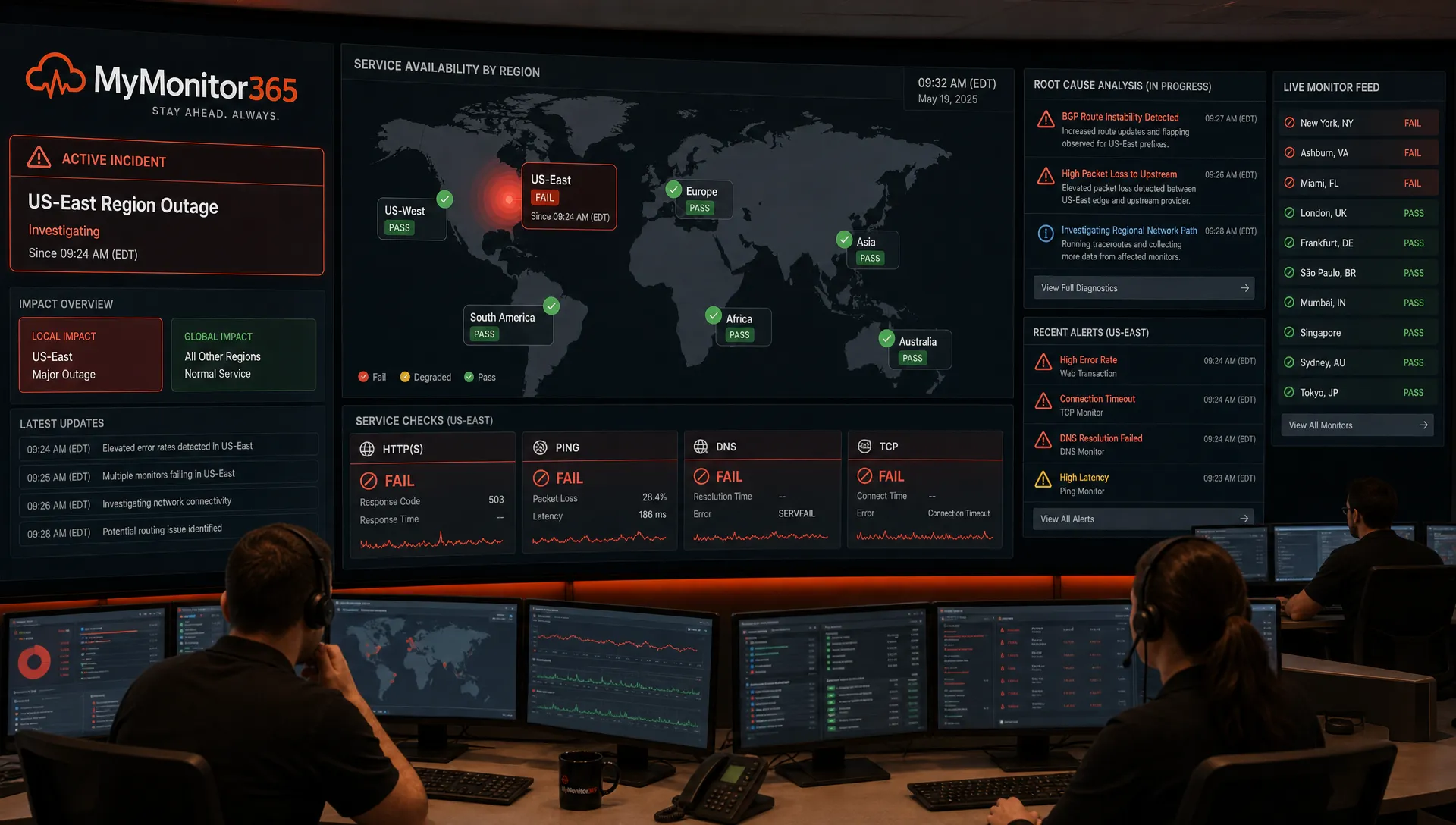
Sharing alerts sounds simple until a production incident exposes the gaps. The security team sees a suspicious DNS change. The infrastructure team sees HTTP failures from one region. The service owner only hears about the issue after customers complain. Everyone had a signal, but no one had the full story fast enough.
For IT managers, network teams, CIOs and IT operations leaders, alert sharing is not about adding more people to more channels. It is about building a shared operating model where the right team gets the right signal, with enough context to act, before the issue becomes user visible.
Security and infrastructure teams often monitor the same assets from different angles. Security looks for exposure, misconfiguration, policy drift and signs of compromise. Infrastructure watches uptime, latency, DNS, SSL, network reachability and service health. When these views stay separate, incidents take longer to triage because every team starts from its own evidence. When they are connected, the organization can distinguish a routine outage from a security relevant event much faster.
Why shared alerts need more than a shared channel
Forwarding every infrastructure alert to security creates fatigue. Sending every security alert to network operations creates the same problem in reverse. Shared alerts work only when teams agree on ownership, severity, context and escalation rules.
A DNS change is a good example. To infrastructure, it may indicate a planned failover, a registrar issue or an accidental record update. To security, it may indicate domain hijacking, unauthorized administrative access or a phishing risk. The signal is useful to both teams, but each team needs different context. A shared alert should say what changed, when it changed, which domain is affected, whether the change was approved and which service owner can confirm intent.
That is why shared alerting sits between monitoring strategy and incident response. If your organization is still treating network and security monitoring as separate disciplines, start by defining where the signals overlap. The operational case is similar to why network and security monitoring must work together: uptime, configuration integrity and exposure are connected in real incidents.
Define which alerts are worth sharing
Not every alert deserves cross-team escalation. A local CPU warning may matter to infrastructure but not security. A failed login alert may matter to security but not network operations. Shared alerts should focus on signals where availability, integrity or trust can be affected.
| Alert type | Why security cares | Why infrastructure cares | Shared response goal |
|---|---|---|---|
| SSL/TLS certificate expiration or mismatch | Users may see trust warnings, attackers may exploit weak certificate hygiene | Public services may become unreachable or degraded | Renew, validate and confirm certificate ownership |
| DNS record change | Unauthorized changes can redirect traffic or expose users | Incorrect records can break routing, email or APIs | Verify authorization and restore expected records if needed |
| HTTP/API failure | Could signal abuse, defacement or application compromise | Indicates downtime, bad deployment or upstream dependency failure | Confirm service impact and isolate root cause |
| Keyword or content mismatch | May reveal defacement, wrong content or failed deployment | Indicates the site is responding but not serving expected content | Validate content integrity and deployment status |
| TCP port failure | Could indicate firewall drift or blocked control plane access | Service dependency may be unreachable | Check network path, firewall rules and service state |
| Multi-location availability issue | Regional anomalies may reveal routing attacks or provider issues | Confirms whether the incident is local, regional or global | Route response to the correct network or provider owner |
This table is not a static policy. Each organization should adapt it to business critical services, regulatory obligations, customer impact and internal support structure. The key is to agree in advance which alert types require cross-functional awareness.
Create a shared alert contract
A shared alert contract defines the minimum information every cross-team notification must contain. Without it, teams waste time asking the same first questions: which service, which environment, who owns it, how severe is it and what changed recently?
| Alert field | Why it matters | Example |
|---|---|---|
| Service name | Prevents ambiguity when multiple systems have similar names | customer-api-prod |
| Environment | Separates production incidents from staging noise | Production |
| Monitor type | Shows which layer detected the issue | HTTP/API, DNS, SSL, ping or TCP |
| Affected location | Helps distinguish regional failures from global outages | Failed from US East, passing from EU West |
| Severity | Sets response urgency across teams | P1, P2, P3 or informational |
| Business impact | Connects technical symptoms to user risk | Checkout unavailable for external users |
| Last known change | Speeds triage and rollback decisions | DNS provider update at 14:10 UTC |
| Primary owner | Avoids duplicate response or unclear accountability | Platform operations |
| Security relevance | Explains why security is included | Unauthorized DNS change not yet ruled out |
| Escalation path | Defines who gets contacted next | Service owner, then incident commander |
The point is not to make alerts long. The point is to make them complete enough that the first responder can decide whether to investigate, escalate, suppress or close.
Normalize severity between teams
Security and infrastructure teams often use different severity models. Infrastructure may classify incidents by downtime and user impact. Security may classify by confidentiality, integrity, exposure and attacker activity. Shared alerts need a translation layer.
A practical model is to define severity by combined operational and security risk.
| Severity | Infrastructure condition | Security condition | Expected action |
|---|---|---|---|
| P1 | Critical service unavailable or major customer impact | Active compromise suspected or trust boundary affected | Immediate joint incident response |
| P2 | Major degradation, regional outage or risky dependency failure | Unauthorized change possible, certificate trust issue or exposed service | Primary team investigates, other team stays engaged |
| P3 | Warning threshold, upcoming expiration or non-critical failure | Policy drift or suspicious but low-confidence signal | Create ticket, assign owner and review within SLA |
| Informational | Expected maintenance, test alert or resolved condition | No security relevance identified | Record for audit or trend analysis |
This mapping prevents overreaction and underreaction. Security does not need to join every latency spike. Infrastructure should not ignore a DNS change just because the web service is still online.
Route alerts by ownership, not by org chart
Many alerting failures happen because alerts are routed to teams instead of owners. A notification that says security plus infrastructure is still vague. A notification that says the primary owner is network operations, with security informed because DNS authorization is unconfirmed, gives everyone a role.
Ownership should be defined at the service level. For each critical website, API, DNS zone, SSL certificate, gateway and network endpoint, document the operational owner, security owner, escalation contact and maintenance authority. This is especially important for MSPs and distributed IT organizations where one team may monitor assets for several business units or customers.
In sectors where infrastructure includes plant-floor systems, engineered machines, lifting equipment or inspection workflows, alert sharing may also extend outside the IT department. Organizations that work with technical service providers for safer engineering and inspection workflows should define which alerts can be shared externally, what data must be redacted and who can authorize corrective action.
Prevent shared alerts from becoming shared noise
The fastest way to break trust in shared alerting is to notify everyone about everything. Alert noise is not just annoying; it changes behavior. Teams mute channels, delay response and start treating urgent notifications as background activity.
Shared alerting should follow a few rules. Page the team that can act first. Inform the team that needs awareness. Escalate only when impact, uncertainty or security relevance increases. Suppress alerts during approved maintenance windows. Group related failures when one dependency causes many symptoms.
For example, if a public API fails from every monitoring location and the TCP check also fails, the first responder may be infrastructure. If the DNS record changed ten minutes before the outage, security should be included immediately. If a planned maintenance window is active and the affected monitors match the change record, the alert can be suppressed or downgraded.
Reducing noise is an operational discipline, not a one-time configuration task. If your team is struggling with too many notifications, the same principles used to reduce alert noise apply here: correlate related signals, normalize severity, use maintenance windows and route based on responsibility.
Build a technical model for shared alerting
A reliable shared alerting model has four layers: monitoring coverage, alert validation, routing logic and review. Each layer should be explicit.
Monitoring coverage defines what is checked. For shared security and infrastructure alerting, that usually includes HTTP/API health, ping or ICMP reachability, TCP ports, SSL certificate validity, DNS records, keyword content checks and multi-location availability. Monitoring from multiple locations is especially valuable because it helps teams separate a local routing issue from a global service failure.
Alert validation reduces false positives. A single failed check might not justify escalation if the next check passes, but a repeated failure across locations should move faster. For SSL, DNS and keyword checks, validation should include the observed value, expected value and timestamp.
Routing logic decides who receives the alert. A DNS change may notify infrastructure as the primary owner and security as a reviewer. An expiring SSL certificate may notify the platform owner first, then security if the certificate reaches a critical threshold. An HTTP 500 from a public login endpoint may notify application operations, infrastructure and security if the error coincides with unusual availability patterns.
Review closes the loop. Every high-severity shared alert should be reviewed after resolution to answer three questions: did the right people receive it, did they receive enough context and should routing change for the next incident?
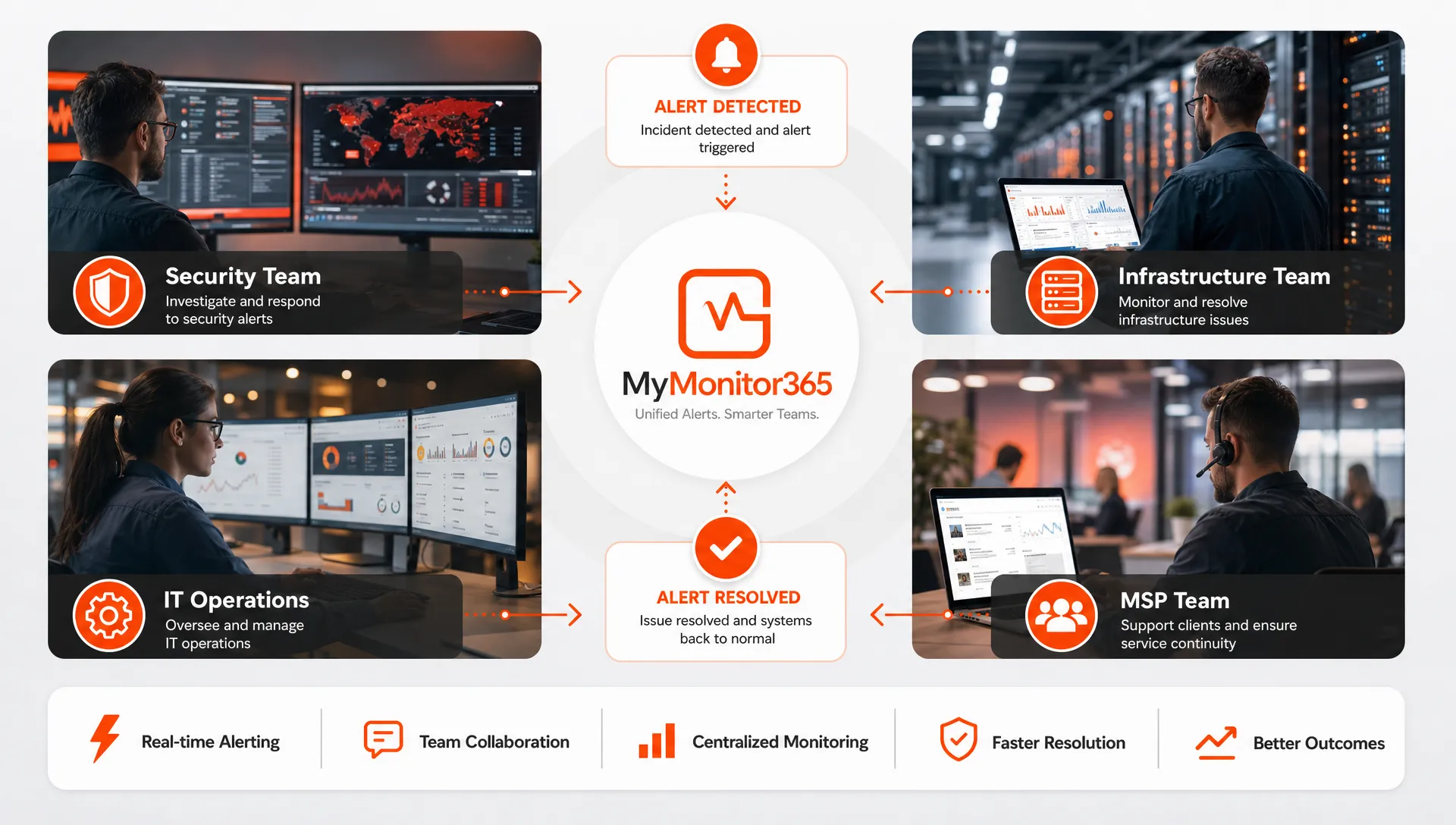
Example shared alert workflows
The best shared alerting policies are easy to test against real incident types. Use scenarios like these to validate whether your teams have enough context and clear ownership.
SSL certificate expiration
A monitor detects that a production certificate will expire soon. Infrastructure needs to renew or replace the certificate. Security needs to know whether the certificate is managed, whether the owner is known and whether expiration would create a trust failure for users.
A good shared alert includes the domain, issuer, expiration date, affected endpoint, service owner and renewal contact. If the expiration window is long, this may be a ticket. If expiration is imminent on a critical service, it becomes an incident.
DNS change detection
A DNS monitor detects a record change for a public service. Infrastructure needs to confirm whether the change matches a planned routing update. Security needs to validate whether the change was authorized and whether traffic could be redirected.
A good alert includes the previous value, new value, record type, DNS zone, observed location, timestamp and expected owner. If no approved change exists, the alert should escalate quickly.
Public website or API outage
An HTTP/API monitor fails from multiple locations. Infrastructure needs to inspect the service, network path, load balancer, upstream dependencies and hosting provider. Security needs enough context to decide whether the outage could be related to abuse, unauthorized change or content tampering.
A good alert includes response code, response time, affected URL, failed locations, last successful check and related DNS or SSL status. If keyword content checks also fail or show unexpected content, security relevance increases.
TCP port failure
A TCP port monitor fails for a critical dependency such as a database gateway, VPN endpoint or mail service. Infrastructure needs to check service state, firewall rules and routing. Security may need to determine whether an access control change was expected or whether exposure has changed.
A good alert includes host, port, protocol, failed locations and known maintenance windows. If the port should never be externally reachable, the same monitoring approach can also help confirm that exposure remains controlled.
Governance for CIOs and IT operations leaders
Shared alerting requires executive support because it crosses team boundaries. CIOs and IT managers should define the policy, but keep the workflow practical enough for responders to use during a live incident.
Start with critical services rather than every asset. Identify public websites, customer APIs, DNS zones, certificate inventories, core network endpoints and high-value internal services. Then assign owners and decide which alerts are shared, which are team specific and which are informational only.
Access control matters too. Alerting systems contain sensitive operational data, including hostnames, domains, internal dependencies and incident history. Protect accounts with two-factor authentication where available. Use audit logs to understand who changed monitors, who adjusted alert rules and who acknowledged incidents. For MSPs, this is also important for customer trust and accountability.
Finally, connect alert sharing to incident response. If a shared alert creates a bridge, ticket or collaboration thread, the alert should remain the source of truth for initial facts. Teams can add investigation details, but they should not lose the original monitor result, timestamp or routing reason.
Metrics that show whether shared alerting is working
You cannot improve alert sharing if you only count the number of alerts sent. Track whether alerts help teams act faster and with less confusion.
| Metric | What it reveals | Healthy trend |
|---|---|---|
| Mean time to acknowledge | Whether the right team receives and trusts the alert | Decreasing for critical services |
| Mean time to resolve | Whether shared context speeds repair | Decreasing for repeated incident types |
| Reassigned alerts | Whether routing is unclear | Fewer reassigned P1 and P2 alerts |
| Duplicate incident threads | Whether teams are working in silos | Fewer parallel investigations |
| Suppressed maintenance alerts | Whether planned work is handled cleanly | Higher suppression accuracy, not blanket muting |
| Security escalations from infrastructure signals | Whether availability alerts reveal risk | Stable and explainable, not random spikes |
Review these metrics monthly. The goal is not zero alerts. The goal is fewer pointless alerts and faster action on the signals that matter.
How MyMonitor365 supports shared alerting
MyMonitor365 helps security and infrastructure teams monitor the layers where operational and security signals often overlap: HTTP/API availability, ping and ICMP checks, TCP ports, SSL security, DNS changes, keyword content checks and multi-location monitoring. Teams can use maintenance windows to reduce planned-work noise, audit logs to support accountability and alert integrations to route notifications into existing collaboration workflows.
If your team is building a broader coverage model, the guide on how to monitor your full infrastructure stack can help you map the layers that should feed your shared alerting policy.
Frequently Asked Questions
Should security receive every infrastructure alert? No. Security should receive alerts where availability, integrity, trust or exposure may be affected. Examples include DNS changes, SSL issues, unexpected content changes, public service outages and suspicious network reachability changes.
How do we decide who owns a shared alert? Assign ownership by service and alert type before incidents happen. The primary owner should be the team that can take the first corrective action. Other teams should be informed or escalated based on severity and risk.
What is the biggest mistake in shared alerting? The most common mistake is sending every alert to a shared channel without context. This creates noise, slows response and makes teams less likely to trust future alerts.
How often should alert routing rules be reviewed? Review high-severity alerts after every major incident and review overall routing rules monthly or quarterly. Changes in infrastructure, service ownership, vendors and risk profile should all trigger updates.
Share alerts before users notice the incident
Security and infrastructure teams do not need more noise. They need shared signals that are actionable, owned and routed with context. When uptime, DNS, SSL, network and content checks feed a clear response model, teams can resolve incidents faster and reduce confusion during the moments that matter.
With MyMonitor365, IT operations teams, network teams and MSPs can monitor critical infrastructure layers, receive timely alerts and build a more coordinated incident response process across security and infrastructure.
Hashtags
#SecurityAndInfrastructure #InfrastructureMonitoring #SecurityOperations #ITOperations #NetworkMonitoring #UptimeMonitoring #IncidentResponse #MSPMonitoring