
How to Secure Your API Against Common Availability Risks
Learn how to secure your API against availability risks with DNS, SSL, rate limit, dependency and monitoring controls for IT teams.
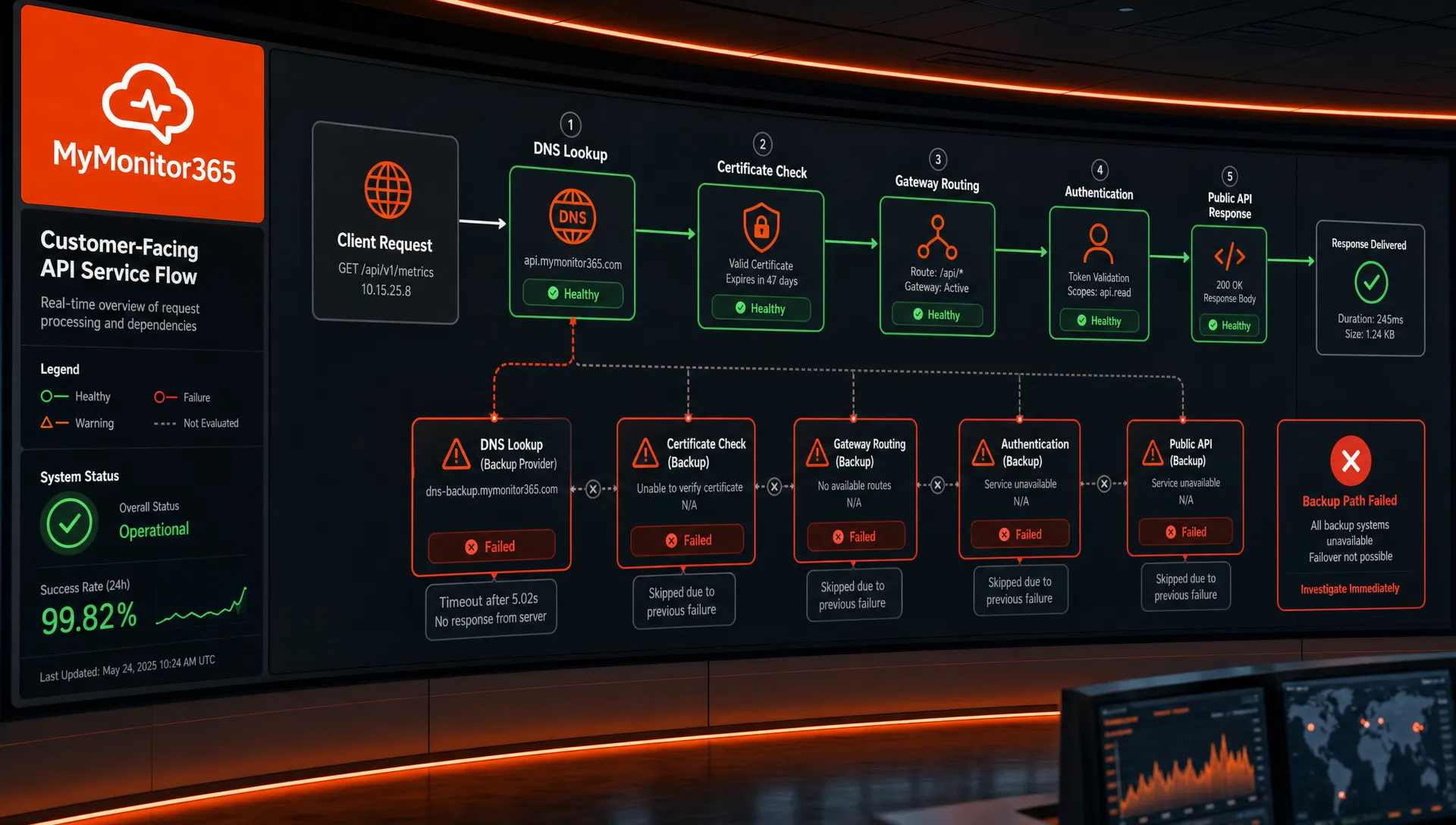
API security conversations often start with authentication, authorization and data exposure. For IT operations, that view is too narrow. If a customer-facing API is unreachable, timing out or returning the wrong response body, the business impact can look exactly like a breach of trust: transactions fail, partners retry until systems are saturated and support teams lose visibility.
To secure your API against common availability risks, treat uptime as part of the security model. Availability is one of the core pillars of information security, and modern APIs sit in the path of payments, identity, fulfillment, telemetry and customer apps. A secure API is not only difficult to abuse. It is also resilient when traffic spikes, certificates change, DNS records drift or a dependency starts failing.
Why API availability is an API security issue
An API outage can be caused by a malicious actor, an accidental configuration change, an expired certificate, a cloud networking issue or a dependency that cannot keep up with demand. From the user's perspective, the cause matters less than the result: the service is unavailable.
That is why availability belongs in API security planning. The OWASP API Security Top 10 includes Unrestricted Resource Consumption as API4:2023, which covers issues such as missing rate limits, expensive requests and unbounded resource use. Those are security weaknesses because they allow normal-looking API calls to consume enough CPU, memory, bandwidth or downstream capacity to degrade the service.
For IT managers and network teams, the practical goal is not to turn every API endpoint into a fortress at the expense of usability. The goal is to define what healthy behavior looks like, enforce limits where abuse or accidental overload is likely, monitor external availability continuously and route incidents to the right owner before customers report them.
Common availability risks that affect APIs
Most API availability incidents are not mysterious. They tend to come from a small set of recurring risks that cross application, network, DNS, certificate and operational boundaries.
| Availability risk | How it usually appears | Preventive control | Monitoring signal |
|---|---|---|---|
| Unrestricted resource consumption | High latency, timeouts, worker exhaustion or database pressure | Rate limits, quotas, payload size limits, timeouts and circuit breakers | Rising response time, 429 responses, 5xx errors or regional failures |
| Dependency failure | API is reachable but critical endpoints fail | Dependency mapping, graceful degradation and health checks | Endpoint-specific failures, changed response content or partial outages |
| DNS misconfiguration | Endpoint resolves to the wrong host or stops resolving in some regions | Controlled DNS changes, record monitoring and provider access controls | DNS lookup failures, unexpected record changes or location-specific failures |
| SSL or TLS failure | Clients reject the connection before reaching the API | Certificate inventory, renewal ownership and chain validation | Expiration warnings, hostname mismatch or certificate chain errors |
| Bad release or configuration change | A deploy breaks routing, authentication, headers or response schema | Release gates, canary checks and rollback criteria | Sudden status code changes, content check failures or error spikes |
| Network path or port issue | API works internally but fails from customer networks | Firewall review, TCP checks and multi-location testing | TCP connection failures, ICMP loss or specific location failures |
| Alerting gap | The outage is visible to users before the team knows | External monitoring, escalation policies and maintenance windows | Delayed detection, duplicate alerts or missed on-call notifications |
This table is useful because it forces one operational question for every risk: how would we know it is happening from outside our own environment?
Control resource usage before abuse becomes downtime
Resource controls are the first layer of availability protection. A public API without practical limits can be brought down by malicious traffic, partner integration bugs or a well-intentioned batch job that retries too aggressively.
Start with endpoint-level limits rather than a single global rule. A login endpoint, search endpoint, file upload endpoint and billing endpoint do not have the same risk profile. Expensive operations need stricter quotas, smaller payload limits and tighter timeout rules. Low-cost read endpoints may tolerate higher throughput but still need protection against bursts and unusual client behavior.
Common controls include rate limiting by client, token, IP range or tenant, maximum request body size, pagination limits, request timeouts and connection limits. For internal service calls, circuit breakers and back pressure prevent one failing dependency from consuming the entire API tier. For workflows that do not need an immediate response, asynchronous queues can absorb spikes without forcing clients to hold open connections.
These controls should be tested, not just documented. Load testing helps validate whether limits fail safely, whether clients receive clear status codes and whether retry behavior makes the problem better or worse. A retry policy that hammers the same endpoint every second during a partial outage can turn a small incident into a platform-wide event.
Monitor externally, not only from inside the stack
Application telemetry is essential, but it does not replace external API monitoring. Internal dashboards often show that the service is up because containers are running, the load balancer is healthy and the database is reachable from inside the network. Customers may still be failing because of DNS resolution, TLS negotiation, routing, regional packet loss or a response body that no longer matches what clients expect.
External monitoring should behave like a real API consumer. It should call the same public endpoint, validate the expected status code, measure response time and confirm that the response body contains the right content. For critical workflows, a simple homepage-style uptime check is not enough. A health endpoint can be useful, but it may hide failures in authentication, search, checkout, account provisioning or partner callbacks.
Multi-location checks are especially valuable for APIs. A single monitoring location can miss regional DNS issues, CDN routing problems, ISP failures or firewall rules that block some networks but not others. If an API supports customers across North America, Europe and Asia, testing from more than one location gives operations teams a better signal about scope and impact.
Treat DNS and certificates as API dependencies
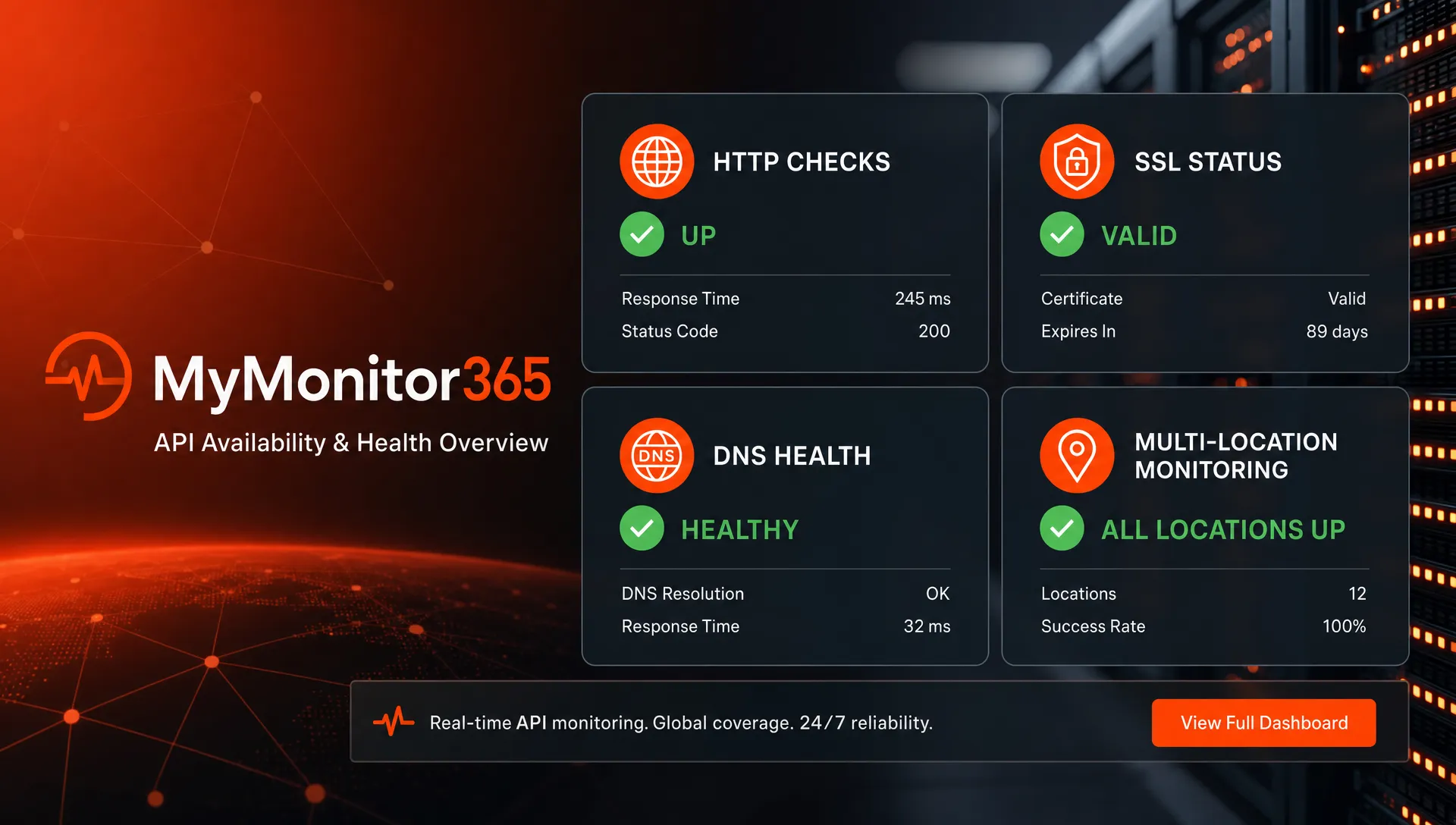
DNS and certificates often sit outside the application team's immediate code path, which makes them easy to underestimate. They are still production dependencies. If the API domain stops resolving or the TLS certificate becomes invalid, the API is effectively offline even if every server behind it is healthy.
API owners should maintain an inventory of critical domains, subdomains, CNAMEs and DNS providers. Changes to records that support API gateways, load balancers, CDNs and identity callbacks should follow the same review process as application releases. For a deeper operational model, MyMonitor365 has a dedicated guide to DNS security best practices for critical domains.
Certificates deserve similar discipline. Track expiration dates, certificate authority changes, hostname coverage, intermediate chains and renewal ownership. Do not rely only on calendar reminders or a single person's inbox. Certificate failures tend to be binary: clients either trust the connection or they do not. If your organization has had near misses, use the checklist in this guide to prevent security certificate expiration issues and add continuous monitoring so warnings appear well before expiration.
Design dependency-aware incident response
APIs rarely fail alone. A public endpoint may depend on authentication providers, DNS, SSL certificates, databases, message queues, payment processors, SaaS platforms, secrets managers, API gateways and firewall policies. If responders only see that the API is returning 500, they may waste time inside the application while the real issue sits in a dependency.
Dependency-aware response starts with a simple map of the critical path for each important endpoint. For example, a customer login API might require DNS resolution, TLS negotiation, API gateway routing, identity provider availability, database access and token signing. A payment API might add fraud checks, processor connectivity and webhook delivery.
That map does not need to be a perfect architecture diagram. It needs enough detail to answer three questions during an incident: which dependency could cause this symptom, who owns that dependency and what signal confirms or rules it out?
This approach also helps teams decide which endpoints deserve the most frequent checks. Not every internal utility endpoint needs the same monitoring depth as an API that supports customer authentication or revenue processing.
Make API alerts operationally useful
An alert that says API down is rarely enough. It tells the on-call engineer something is wrong but gives little guidance about scope, severity or next action. Better alerts carry context that shortens triage.
Useful API alerts usually include the affected endpoint, expected and actual status code, response time, monitoring location, last successful check, failure duration, validation error and escalation owner. If the failure may be related to DNS, SSL or a TCP connection, the alert should say so instead of forcing responders to infer it from a generic timeout.
Alert routing matters just as much as alert content. Security teams may need visibility into suspicious traffic and certificate changes, but network teams may own DNS, firewall and connectivity incidents. Application teams may own response schema, status code changes and dependency failures. MSPs also need a clear process for separating client-impacting incidents from noise, especially when one shared provider affects multiple customers.
Maintenance windows reduce false alarms during planned changes, but they should not become blind spots. If a deployment window suppresses every signal, responders may miss a separate DNS or certificate issue that appears at the same time. Use maintenance windows to control notification behavior, not to stop collecting availability data.
Use audit logs and change windows to catch self-inflicted outages
Many API availability incidents begin as legitimate changes. A DNS record is edited, a certificate renewal automation fails, a firewall rule is tightened, a deployment changes response headers or an identity provider setting is updated. None of these actions are malicious, but each can remove access for real users.
Audit logs give incident responders a timeline. If an API begins failing at 10:07 and a related DNS, certificate, port or gateway configuration changed at 10:05, the team has a fast path to investigation. Without that history, response turns into guesswork.
Treat changes to API infrastructure as availability events. Record who made the change, what changed, when it changed and which services could be affected. Pair that with external monitoring so the team can see whether the customer-facing behavior changed after the configuration update.
A practical API availability hardening checklist
A useful hardening program is specific enough to run, but simple enough to maintain. Use this checklist as a starting point for production APIs.
| Area | Questions to answer |
|---|---|
| Criticality | Which APIs support revenue, authentication, operations or customer-facing workflows? |
| Resource protection | Which endpoints need rate limits, quotas, payload limits, timeouts or circuit breakers? |
| External monitoring | Are key endpoints checked from outside the network and from more than one location? |
| Response validation | Do checks confirm only availability, or do they also validate expected status codes and content? |
| DNS and SSL | Are API domains, DNS records and certificates inventoried and continuously monitored? |
| Dependencies | Does each critical endpoint have a simple dependency map and owner list? |
| Alerting | Do alerts include enough context for the right team to act quickly? |
| Change control | Are DNS, SSL, firewall, gateway and deployment changes visible in logs? |
| Maintenance | Are planned changes covered by maintenance windows without hiding unrelated failures? |
The most mature teams revisit this checklist after incidents. Every outage should produce one of three outcomes: a better control, a better monitor or a better escalation path.
Metrics IT leaders should track
CIOs and IT operations leaders do not need every low-level signal, but they do need reliable availability metrics that reflect customer impact. API reporting should connect technical symptoms to business risk.
| Metric | What it tells you | Why it matters |
|---|---|---|
| External uptime by endpoint | Whether users can reach the API from outside your environment | Internal health does not always equal customer availability |
| P95 or P99 response time | How slow the API is for higher-latency users | Slow APIs can trigger timeouts, retries and partner failures |
| Error rate by status class | Whether failures are client-side, server-side or rate-limit related | Different status codes point to different owners and fixes |
| DNS and SSL incident count | How often non-application dependencies affect availability | These failures are preventable with ownership and monitoring |
| Mean time to detect | How long it takes to know there is a problem | Faster detection reduces user-reported incidents |
| Mean time to acknowledge | How quickly the right person engages | Alert routing and escalation quality show up here |
| Mean time to restore | How long service impact lasts | This is the clearest operational resilience measure |
Avoid reporting only a monthly uptime percentage. A 99.9 percent result can still hide repeated short failures during peak usage, regional outages or degraded response times that break partner integrations. Pair availability with latency, scope and incident cause.
Frequently Asked Questions
What is the first step to secure your API against availability risks? Start by identifying the APIs that support critical workflows, then define expected behavior for each endpoint. That includes status codes, latency targets, response content, dependencies and ownership. Once that baseline exists, you can add resource controls and external monitoring.
Is API monitoring the same as application performance monitoring? No. Application performance monitoring usually focuses on internal telemetry such as traces, logs and service metrics. API monitoring tests the service from the outside, similar to a customer or partner, and can detect DNS, SSL, network and content failures that internal metrics may miss.
How often should critical API endpoints be checked? Check frequency should match business impact. Revenue, authentication and customer-facing APIs often need frequent external checks from multiple locations. Lower-risk internal APIs may need less frequent monitoring, but they still need enough coverage to detect failures before they affect dependent systems.
Can DNS or SSL issues really take an API offline? Yes. If DNS resolution fails or a certificate is expired, mismatched or untrusted, clients may never reach the application layer. Servers can be healthy while the API is unavailable to users.
What should MSPs monitor for client APIs? MSPs should monitor endpoint availability, response time, expected content, DNS records, SSL certificate status, TCP connectivity and location-specific failures. They should also define escalation ownership so client, network and application teams know who acts first.
How do maintenance windows fit into API security? Maintenance windows prevent planned work from creating unnecessary alert noise, but they should not remove visibility. Continue collecting API availability data during changes so your team can confirm whether a deployment, DNS edit or certificate update affected users.
Secure your API with continuous availability monitoring
API availability is not a one-time hardening task. It is an operating discipline that combines resource controls, dependency visibility, DNS and SSL hygiene, external checks and actionable alerts.
MyMonitor365 helps IT teams and MSPs monitor HTTP/API endpoints, SSL security, DNS changes, TCP ports, ping and ICMP checks from multiple locations, with alert integrations, maintenance windows and audit logs. If your team wants to resolve outages before users notice, start with the free plan, no credit card required.
Suggested hashtags
#APISecurity #UptimeMonitoring #NetworkMonitoring #ITOperations #MSP #IncidentResponse #MyMonitor365