
Domain Security Checks That Prevent Hijacking and Outages
Domain security checks to prevent hijacking, DNS tampering and outages. Use this practical monitoring checklist to protect critical domains.
Domain hijacking rarely starts with a dramatic alarm. It often begins with a small control failure: an old registrar account, a nameserver update outside the change window, an expired certificate or a DNS record that points to the wrong place. To users, the result is simple. Your website, app, email or API stops working, or worse, resolves to infrastructure you do not control.
For IT managers, network teams, CIOs and IT Operations leaders, domain security is an availability discipline as much as a security discipline. The right checks reduce the risk of hijacking, catch misconfiguration early and shorten the time between a bad change and a verified fix.
What domain security checks need to prove
A domain is not just a name. It is the control point for customer access, authentication flows, email delivery, APIs, partner integrations and brand trust. Good domain security checks should prove five things continuously:
- The domain registration is owned by the right organization and cannot be transferred casually.
- Authoritative nameservers match the approved configuration.
- DNS records resolve to expected infrastructure from the regions your users rely on.
- DNSSEC, SSL/TLS and certificate records do not block legitimate traffic.
- Your team receives alerts fast enough to act before users flood the service desk.
This is where many domain programs fall short. They document registrar settings once, then treat DNS as stable until a migration, outage or security event forces a review. A better model combines periodic governance checks with continuous DNS, SSL and uptime monitoring.
1. Registrar ownership and transfer checks
The registrar is the first administrative control plane for your domain. If an attacker gains access there, they may be able to change nameservers, update contact details, disable protections or initiate a transfer. Even if your DNS provider is well secured, registrar compromise can bypass it.
At minimum, every critical production domain should have a registrar checklist that includes account ownership, multi-factor authentication, role-based access, billing continuity and transfer protection. For high-value domains, registry lock is worth evaluating because it adds another approval layer before sensitive registry-level changes can occur.
The checks are straightforward, but they need owners. Confirm the domain is registered under the correct legal entity, not a former employee or agency. Review administrative and technical contacts. Validate renewal settings and payment methods. Confirm that domain lock or transfer lock is enabled. Document who can approve changes and how approvals are verified.
These are not uptime probes, but they directly affect uptime. An expired domain, failed renewal or unauthorized transfer can take down web, email and API access at once.
2. Nameserver and authoritative DNS checks
Nameserver changes are among the most important signals in domain security. A domain can have perfect A records, MX records and certificates, but if the authoritative nameservers are replaced, users will receive whatever answers the new authority provides.
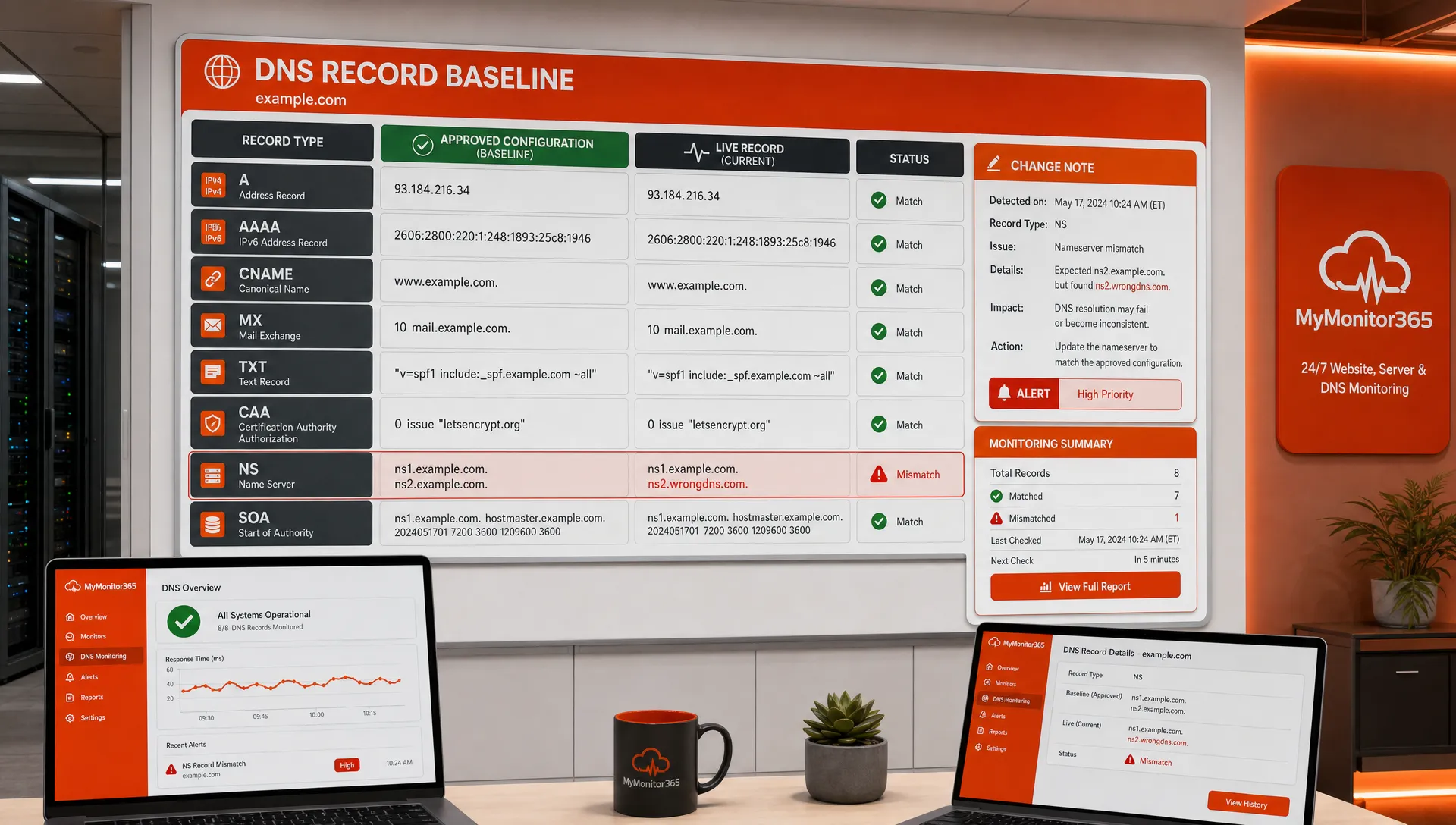
Your monitoring should compare the live nameserver set against a known-good baseline. That baseline should include the expected NS records, parent-zone delegation, glue records where applicable and SOA details. Check from multiple networks because DNS caching and regional propagation can hide a change from one location while another region already sees the new authority.
If you are formalizing this layer, MyMonitor365 has a deeper guide to DNS security best practices for critical domains, including how to classify domains and monitor important changes without overwhelming the team.
A nameserver alert should not be treated as routine noise. It deserves a fast triage path: confirm whether a planned change was approved, verify the registrar account activity, compare DNS answers from the old and new authorities and check whether users are being routed to unexpected infrastructure.
3. DNS record integrity checks
Most domain-related outages come from record-level mistakes rather than full domain takeover. A CNAME is pointed at a retired endpoint. An A record is updated for a migration but the old system still receives traffic because of TTL behavior. A TXT record is overwritten during a SaaS verification step. An MX record is edited and inbound mail begins to queue or bounce.
Core DNS records should be monitored against a baseline. For most organizations, the priority set includes A, AAAA, CNAME, MX, TXT, CAA, NS, SOA and any records used for service discovery. For APIs and customer-facing applications, also monitor records tied to login, payment, status pages, CDN edges and partner integrations.
A useful baseline is not just a list of records. It captures expected values, owners, business purpose, TTLs and change windows. When an alert fires, the responder should be able to tell whether the change belongs to a release, a vendor verification, a failover event or an incident.
| Check | What it helps prevent | Alert when |
|---|---|---|
| Registrar lock and ownership review | Unauthorized transfer or loss of control | Lock is disabled, owner data changes or renewal risk appears |
| Nameserver baseline | Domain hijacking and delegation mistakes | NS records differ from the approved set |
| A, AAAA and CNAME monitoring | Website and API routing outages | Records point to unexpected hosts or IPs |
| MX and TXT monitoring | Email disruption and spoofing-control drift | Mail routing or authentication records change unexpectedly |
| CAA monitoring | Unauthorized or failed certificate issuance | Approved certificate authorities change |
| DNSSEC validation | Resolution failure for validating resolvers | DS, DNSKEY or signatures become invalid |
| SSL/TLS checks | Browser warnings and failed HTTPS connections | Certificate expires, mismatches hostname or chain breaks |
4. DNSSEC checks that protect without breaking resolution
DNSSEC can reduce the risk of forged DNS answers, but it also introduces operational dependencies. A wrong DS record at the parent zone, expired signatures or a key rollover mistake can make a valid domain fail for resolvers that enforce DNSSEC validation.
The practical domain security check is simple: validate the chain from the root to your zone, confirm DS and DNSKEY alignment, monitor signature validity and test resolution using validating resolvers. DNSSEC should also be part of your change management process. Key rollovers, provider migrations and DNS switching events deserve rehearsed steps and rollback plans.
DNSSEC failures can look like regional outages because not every resolver validates in the same way. That is why multi-location checks matter. If one region fails and another succeeds, you need resolver-path evidence quickly instead of guessing whether the web server, CDN or DNS provider is at fault.
5. SSL, web and network checks that confirm the domain still works
DNS can be correct while the user experience is still broken. Once a domain resolves, users still need to establish a trusted HTTPS session and receive the expected content or API response. Domain security monitoring should connect DNS signals with SSL, HTTP and network checks.
SSL/TLS checks should validate certificate expiration, hostname coverage, issuer, chain completeness and security posture. CAA records should align with your certificate authority policy, otherwise a renewal can fail at the worst time. If certificate reliability is a recurring risk, review these HTTPS certificate checks that prevent costly outages and fold them into the same domain runbook.
HTTP and API checks add another layer of confidence. A successful 200 response is useful, but it is not always enough. Keyword content checks can verify that the expected page, status message or API payload appears. This helps catch defacement, parking pages, CDN misroutes and authentication gateway errors that basic availability checks may miss.
TCP port monitoring and ping or ICMP checks help separate DNS problems from network reachability problems. If DNS resolves correctly but HTTPS fails, the next question is whether the target host is reachable, the port is open and the service is responding. That evidence shortens incident calls and keeps teams from escalating blindly.
6. Alert patterns that deserve immediate escalation
Not every DNS change is an emergency, but some patterns should trigger a security-minded response rather than a normal outage workflow.
Escalate quickly when you see unexpected nameserver changes, registrar contact changes, CAA changes before a certificate event, DNSSEC validation failures, production records pointing to unknown infrastructure, sudden wildcard records, MX changes outside a mail migration or web content that no longer matches the approved application.
Context also matters. If several signals change together, treat the event as higher risk. A nameserver change plus a new certificate plus unexpected HTTP content is not just a DNS ticket. It may indicate domain takeover, provider compromise or a botched migration with user-facing impact.
Whether the domain supports customer login, public APIs, ecommerce or production content workflows such as Virtuall's Creative AI OS, the same principle applies: the domain is part of the operational supply chain and needs continuous verification.
7. A practical monitoring model for IT and MSP teams
The cleanest approach is to separate domain security checks into three layers: governance, configuration and live service validation.
Governance checks confirm registrar access, MFA, renewal status, lock settings, ownership and approval paths. These do not need minute-by-minute monitoring, but they should be reviewed on a defined schedule and after staff, vendor or ownership changes.
Configuration checks watch DNS and certificate state. These include nameservers, record baselines, DNSSEC status, CAA records and SSL/TLS health. They should alert when production values drift from what was approved.
Live service checks verify that users can reach the service through the domain. These include HTTP/API monitoring, keyword checks, ping or ICMP checks, TCP port checks and multi-location testing. This layer catches the impact of mistakes even when the root cause sits elsewhere.
For MSPs, this model also creates clean reporting. You can show clients which domains are covered, what signals are monitored, what changed during the month and which incidents were prevented or reduced through early alerts.
| Layer | Primary owner | Typical cadence | Evidence to keep |
|---|---|---|---|
| Governance | IT leadership, security, domain owner | Monthly or quarterly, plus after org changes | Registrar settings, access list, renewal proof, approval contacts |
| Configuration | Network, DNS, platform teams | Continuous for critical domains | DNS baselines, change history, DNSSEC status, certificate state |
| Live validation | IT Operations, NOC, MSP team | Continuous | Uptime checks, regional results, alert timeline, incident notes |
How MyMonitor365 supports domain security operations
MyMonitor365 helps teams connect domain security with real availability monitoring. You can monitor HTTP and API endpoints, run ping and ICMP checks, watch TCP ports, validate SSL security, track DNS changes and test services from multiple locations. For operational control, maintenance windows reduce false alarms during approved work, while alert integrations help route incidents to the teams already handling response.
The platform does not replace strong registrar governance or internal approval processes. It strengthens them by catching the signals that indicate a bad change, failed certificate, DNS drift or service impact. Audit logs and two-factor authentication also support the control environment around your monitoring setup, which matters when monitoring itself becomes part of your incident-response workflow.
If your organization is already combining availability and security operations, the case for shared signals is even stronger. The MyMonitor365 article on why network and security monitoring must work together explains how DNS, SSL and reachability data can help both teams detect problems earlier.
Frequently Asked Questions
What is domain security in an IT operations context? Domain security is the set of controls and monitoring practices that protect domain ownership, DNS configuration, certificate trust and domain-based service availability. It covers registrar governance, DNS integrity, SSL/TLS health and live reachability checks.
Which domain security checks prevent hijacking? The most important checks are registrar account protection, MFA, domain transfer lock, registry lock for critical domains, nameserver baseline monitoring, DNS record change alerts and fast investigation of unexpected delegation changes.
Can DNS monitoring detect every domain hijacking attempt? DNS monitoring cannot detect every registrar or account-level attack before a change occurs, but it can detect high-impact symptoms such as nameserver changes, unexpected DNS answers, DNSSEC failures and traffic routing to unauthorized infrastructure.
How often should critical domains be checked? Live DNS, SSL, HTTP and network checks should run continuously at an interval appropriate to the service criticality. Registrar ownership, access control and renewal settings should be reviewed on a defined schedule and whenever vendors, employees or business ownership changes.
Should domain security checks include SSL certificates? Yes. A domain can resolve correctly and still be unavailable if the certificate is expired, mismatched or issued from an unexpected authority. SSL monitoring is a core part of protecting domain-based availability and user trust.
Strengthen domain security before the next outage
Domain incidents are easier to prevent than to explain after customers lose access. Start with a critical-domain inventory, define approved baselines, review registrar controls and connect DNS, SSL, HTTP, API and network checks into one response workflow.
With MyMonitor365, IT and MSP teams can monitor the signals that turn domain security from a static checklist into an operational safety net.
Hashtags
#DomainSecurity #DNS #UptimeMonitoring #NetworkMonitoring #ITOperations #MSP #SSLMonitoring #CyberResilience