
How to Measure and Improve Your Security Posture
Learn how to measure security posture with practical metrics, risk scoring, monitoring signals, and a 30-day plan to improve resilience.
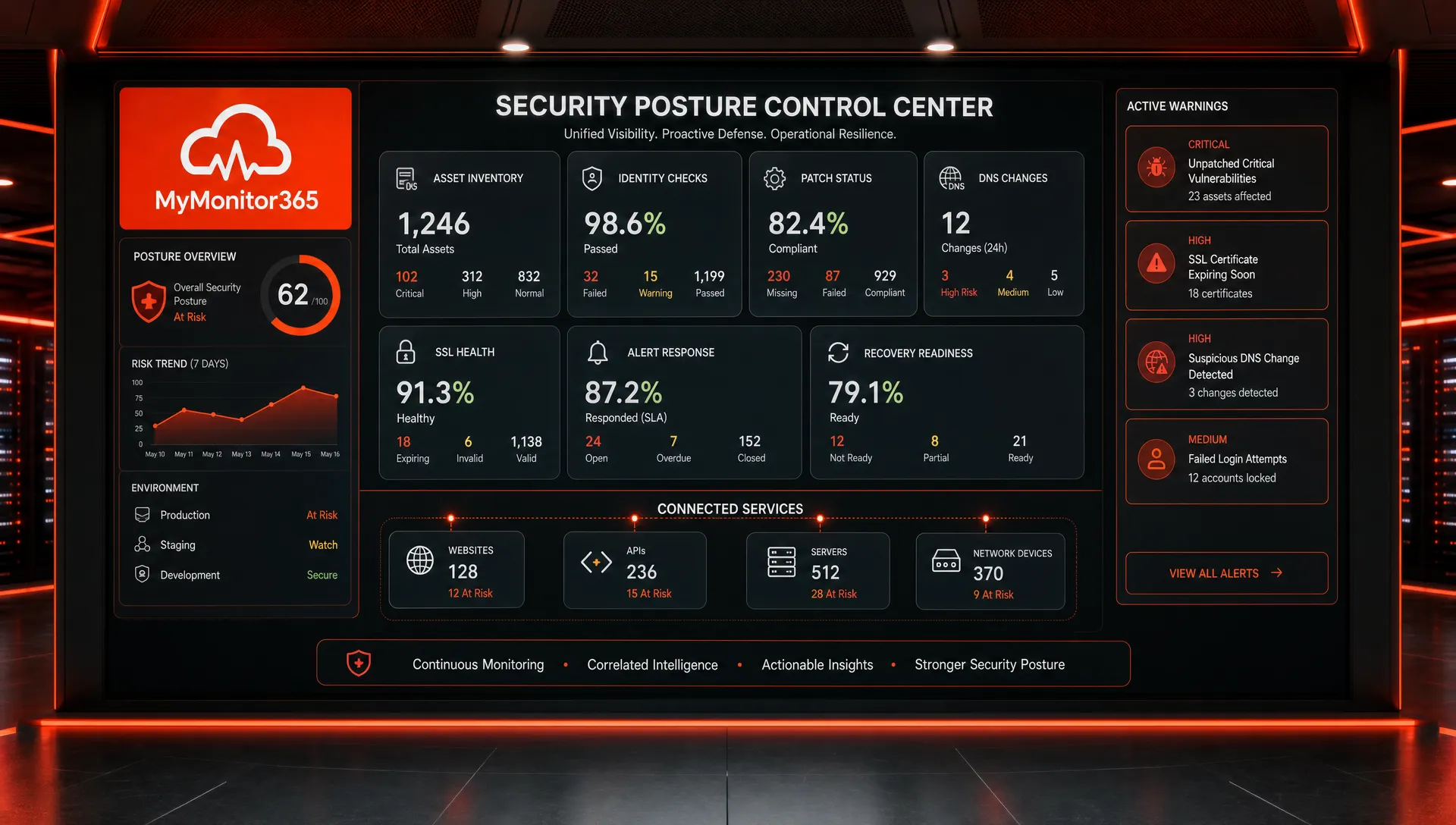
A strong security posture is not a one-time audit result. It is the current state of your organization’s ability to prevent, detect, respond to, and recover from security events across infrastructure, applications, identities, vendors, and operational processes.
For IT managers, network teams, CIOs, and IT Operations leaders, the challenge is practical: how do you turn a broad concept like “posture” into measurable evidence and repeatable improvements? The answer is to combine risk-based assessment, continuous monitoring, and operational discipline.
What security posture really means
Your security posture is the combined strength of your defenses and your readiness to handle incidents. It includes technical controls like patching, DNS security, SSL/TLS hygiene, endpoint protection, access controls, and network segmentation. It also includes non-technical factors, such as ownership, escalation paths, training, documentation, and change management.
A useful posture assessment answers three questions:
- What could go wrong?
- How likely is it to happen?
- How quickly would we know and respond?
That last question is often overlooked. Many organizations have reasonable preventive controls but weak visibility. If a critical certificate expires, DNS records change unexpectedly, an API endpoint stops responding, or a public service becomes reachable on the wrong port, the organization’s risk increases immediately. Security posture is therefore not only about hardening. It is also about knowing when something has drifted from a safe state.
The NIST Cybersecurity Framework 2.0 is a helpful reference because it organizes cyber risk management into six functions: Govern, Identify, Protect, Detect, Respond, and Recover. You do not need to adopt every part of the framework at once, but it gives IT leaders a balanced model for measuring posture beyond simple compliance checklists.
Start by defining what you need to protect
Before you measure security posture, define your scope. Many assessments fail because they start with tools instead of business impact. A public marketing website, a customer API, a VPN gateway, a payment system, and an internal file server do not carry the same operational or security risk.
Create an asset and dependency inventory that includes:
- Internet-facing domains, subdomains, APIs, and portals
- Servers, cloud workloads, network devices, and managed services
- DNS zones, SSL/TLS certificates, registrars, and certificate authorities
- Identity providers, privileged accounts, and administrative consoles
- Third-party services that support availability, authentication, payments, support, or delivery
- Business owners and technical owners for each critical service
Include specialized environments that may not fit neatly into traditional IT categories. For example, organizations running uptime-sensitive workloads, including crypto mining operations in the UAE, should account for hosting dependencies, hardware availability, network paths, remote access controls, and vendor support processes when assessing operational risk.
Once the inventory exists, classify assets by criticality. A simple tiering model works well: Tier 1 for revenue, safety, identity, or customer-facing services; Tier 2 for important internal operations; Tier 3 for lower-risk systems. This helps you prioritize improvements where they reduce the most risk.
Build a security posture measurement model
A good measurement model combines qualitative judgment with quantitative evidence. Avoid relying only on a single maturity score. A score can be useful for executive reporting, but it should be backed by observable metrics.
| Posture area | Questions to answer | Example evidence |
|---|---|---|
| Asset visibility | Do we know what we own and expose? | Current asset inventory, domain list, external exposure scan |
| Identity security | Are privileged accounts protected? | MFA coverage, admin account review, access logs |
| Vulnerability management | Are known risks fixed quickly? | Patch age, vulnerability SLA compliance, CISA KEV checks |
| Configuration integrity | Do critical settings drift unexpectedly? | DNS change logs, firewall rule reviews, cloud configuration reviews |
| Availability and resilience | Can critical services stay reachable? | Uptime checks, multi-location monitoring, failover tests |
| Detection and response | Will we know when something breaks or changes? | Alert coverage, incident timelines, escalation tests |
| Recovery readiness | Can we restore service and data? | Backup test results, recovery time evidence, runbooks |
The goal is not to make every metric perfect. The goal is to identify where risk is high, where evidence is weak, and where improvement would materially reduce business exposure.
Key metrics for measuring your security posture
Security posture metrics should be understandable, repeatable, and tied to action. If a metric does not influence a decision, reconsider whether it belongs in your scorecard.
Exposure metrics
Exposure metrics show what attackers, misconfigurations, or outages could affect from the outside. Examples include the number of internet-facing assets, unexpected open ports, expired or soon-to-expire certificates, weak TLS configurations, missing DNS protections, exposed admin panels, and unsupported software versions.
DNS deserves special attention because it is both a reliability dependency and a security control point. A small unauthorized DNS change can redirect traffic, break email, disrupt authentication, or create a phishing risk. If DNS is a major part of your attack surface, review practical DNS security best practices for critical domains and include DNS ownership, record integrity, access controls, and monitoring in your posture measurements.
Control health metrics
Control health metrics measure whether your defenses are actually working. Examples include multi-factor authentication coverage for privileged accounts, patch compliance by system tier, endpoint protection coverage, backup success and restore test rates, logging coverage, and certificate renewal compliance.
For identity security, do not stop at “MFA is enabled.” Measure where it is enforced, who is exempt, which methods are allowed, and whether administrative access requires stronger controls. IT teams can strengthen this area by applying proven two-factor authentication best practices to privileged users, remote access, and control-plane systems.
Detection and response metrics
Detection metrics answer whether your team can identify abnormal conditions quickly. Response metrics show whether the organization can act on those signals. Common examples include mean time to detect, mean time to acknowledge, mean time to resolve, alert noise rate, incident escalation success rate, and runbook completion rate.
For IT Operations, this is where security and reliability overlap. An outage, certificate failure, DNS change, or unreachable port may be operational at first glance, but it can also indicate compromise, misconfiguration, or vendor failure. That is why many teams are moving toward a combined model where network and security signals support the same incident workflow. If you are building that model, it helps to understand why network and security monitoring must work together.
A practical 30-day security posture assessment
You can make meaningful progress in 30 days without launching a large consulting project. The key is to focus on evidence, not assumptions.
- Map critical services and owners: Identify the services that would cause the most business impact if they failed or were compromised. Assign a business owner and technical owner to each one.
- Review external exposure: Check domains, subdomains, certificates, public IPs, ports, APIs, and third-party dependencies. Look for unknown assets, stale records, and management interfaces that should not be public.
- Validate core controls: Confirm MFA, privileged access reviews, patch status, endpoint coverage, backup status, and logging for your highest-risk systems.
- Test detection paths: Trigger safe test alerts for website downtime, SSL expiry, DNS changes, blocked endpoints, and failed dependencies. Confirm alerts reach the right people through the right channels.
- Score and prioritize risks: Rate findings by likelihood, business impact, exploitability, and ease of remediation. Separate urgent fixes from longer-term architecture work.
By the end of 30 days, you should have a clear view of your most important gaps and a prioritized remediation plan. The output should be simple enough for executives to understand and detailed enough for technical teams to execute.
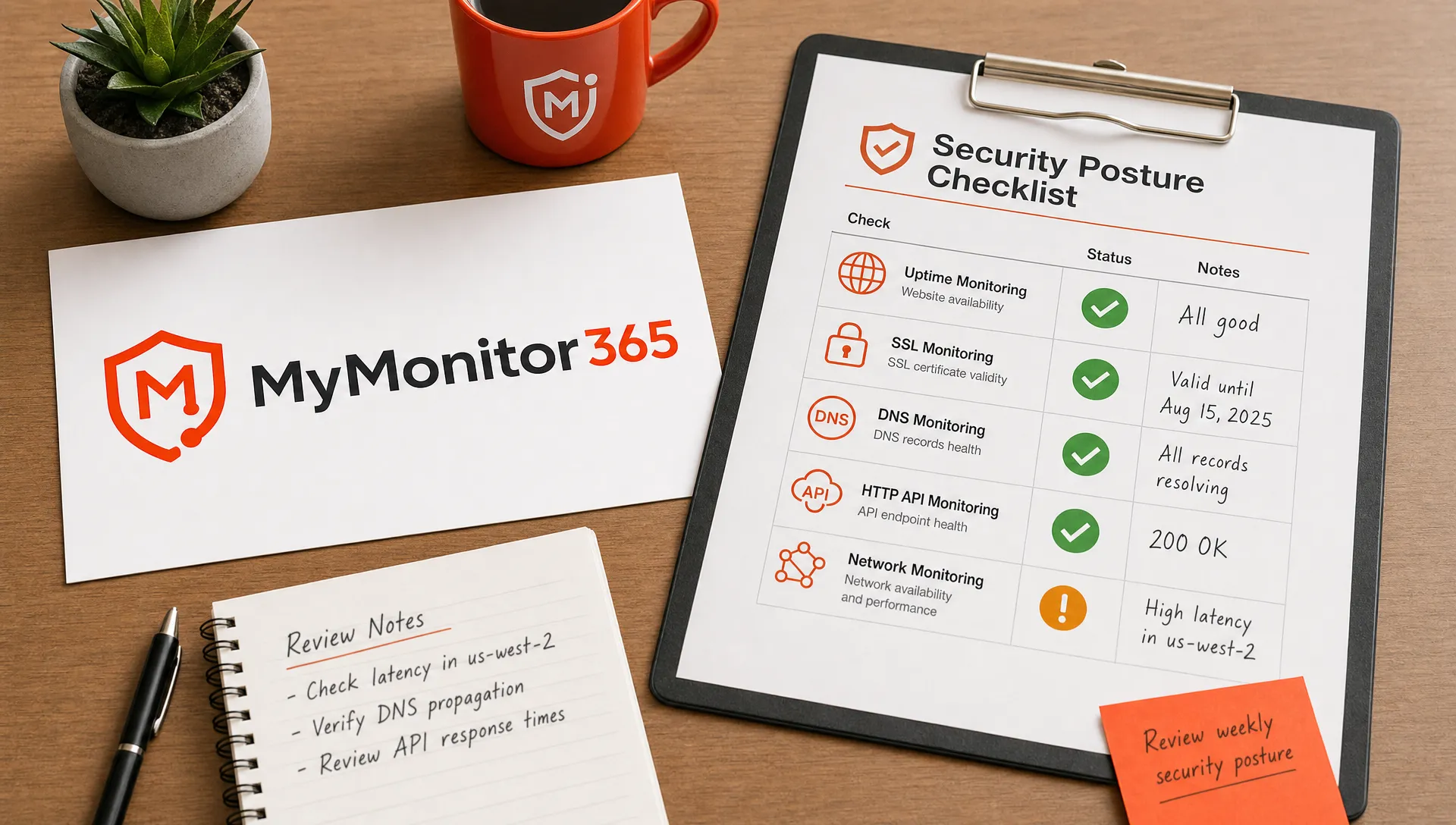
How continuous monitoring improves security posture
Point-in-time assessments are useful, but posture changes every day. Teams deploy new services, certificates approach expiry, DNS records change, firewall rules evolve, vendors experience outages, and attackers scan for newly exposed weaknesses. Continuous monitoring helps detect those changes before they become incidents.
MyMonitor365 supports this operational layer by monitoring uptime, performance, and security-related signals across websites, servers, DNS, SSL, and network services. For IT and MSP teams, checks such as HTTP/API monitoring, ping and ICMP checks, TCP port monitoring, SSL security monitoring, DNS change monitoring, keyword content checks, and multi-location monitoring can provide early warning when critical services drift from expected behavior.
| Monitoring signal | What it can reveal | Posture improvement action |
|---|---|---|
| SSL/TLS checks | Expiry risk, certificate mismatch, chain issues | Renew certificates early and standardize ownership |
| DNS monitoring | Unauthorized or accidental record changes | Tighten registrar access and validate change approvals |
| HTTP/API checks | Application downtime or unexpected response changes | Improve runbooks and escalation paths |
| TCP port checks | Service availability or unexpected exposure | Review firewall rules and service hardening |
| Multi-location checks | Regional reachability or provider issues | Validate redundancy and dependency design |
| Keyword content checks | Unexpected page content or defacement indicators | Investigate content integrity and deployment controls |
Continuous monitoring is not a replacement for vulnerability management, endpoint security, or identity governance. Instead, it provides a practical feedback loop. It helps teams know whether critical services are reachable, whether important configurations changed, and whether response processes are working.
Prioritize improvements by risk, not noise
Security posture programs often stall because every finding looks urgent. A missing header on a low-traffic site should not compete equally with an exposed admin console on a production system. Use a risk-based formula that considers:
- Business impact if the asset fails or is compromised
- Internet exposure and attacker accessibility
- Known exploitation activity or vulnerability severity
- Control gaps, such as missing MFA or weak logging
- Detection confidence and response readiness
- Remediation effort and operational risk
For vulnerability prioritization, the CISA Known Exploited Vulnerabilities Catalog is a valuable source because it identifies vulnerabilities known to be exploited in the wild. Combining exploit evidence with business context helps teams focus on the work that reduces real risk fastest.
Quick wins often include enforcing MFA on privileged accounts, removing stale DNS records, renewing certificates before emergency windows, disabling unused public services, adding monitoring for Tier 1 assets, documenting escalation paths, and creating maintenance windows so planned changes do not create false incident noise.
Turn posture into an executive scorecard
CIOs and IT leaders need a security posture view that is accurate but not overloaded with technical detail. A good executive scorecard should show trends, coverage, and risk reduction over time.
Consider reporting these indicators monthly:
| Executive indicator | Why it matters |
|---|---|
| Critical asset monitoring coverage | Shows whether high-impact systems have visibility |
| High-risk findings open by age | Reveals whether serious risks are being resolved |
| MFA coverage for privileged accounts | Measures identity control strength |
| Certificate and DNS hygiene | Tracks common causes of outages and security incidents |
| Mean time to acknowledge critical alerts | Measures operational responsiveness |
| Backup and recovery test success | Shows resilience after failure or compromise |
| Repeat incidents by category | Identifies systemic weaknesses |
Use red, amber, and green status carefully. Green should mean evidence supports the claim, not simply that no one reported a problem. Amber should trigger a clear owner and next step. Red should indicate a decision is needed, such as funding, staffing, technology changes, or risk acceptance.
Common mistakes to avoid
One common mistake is confusing compliance with security posture. Compliance can prove that controls exist at a specific point in time. Posture measures whether those controls remain effective under real operating conditions.
Another mistake is measuring too many things. A long spreadsheet of low-value metrics can create the illusion of control while hiding critical gaps. Start with a small number of metrics tied to your most important assets, then mature from there.
A third mistake is ignoring operational drift. Even well-designed environments degrade when teams make urgent changes, vendors update platforms, certificates expire, or ownership changes. This is why continuous checks, audit logs, alert integrations, and maintenance windows matter. They help preserve signal quality and make posture measurable day to day.
Frequently Asked Questions
What is security posture? Security posture is the current condition of an organization’s defenses, visibility, response readiness, and resilience against cyber threats and operational failures.
How do you measure security posture? Measure it with a combination of asset visibility, exposure data, control health, vulnerability status, detection coverage, response metrics, and recovery evidence.
How often should security posture be reviewed? Critical signals should be monitored continuously, while executive posture reviews are commonly performed monthly or quarterly. High-risk changes should trigger immediate reassessment.
What is the difference between risk assessment and security posture? A risk assessment identifies and evaluates specific risks. Security posture is broader and reflects the overall state of controls, monitoring, processes, and readiness.
Can uptime monitoring improve security posture? Yes. Uptime, SSL, DNS, HTTP/API, and TCP monitoring can reveal outages, misconfigurations, certificate failures, unauthorized changes, and other conditions that may affect both reliability and security.
Strengthen your posture with better visibility
Improving security posture starts with knowing what matters, measuring it consistently, and acting quickly when conditions change. For IT Operations and MSP teams, that means pairing governance and risk management with real-time visibility into critical infrastructure.
MyMonitor365 helps teams monitor websites, servers, DNS, SSL, APIs, and network services with instant alerts, multi-location checks, maintenance windows, audit logs, and integrations for operational response. Start with your highest-impact services, close the most visible gaps, and build a posture program that improves every month.
Hashtags
#SecurityPosture #CyberSecurity #ITOperations #NetworkMonitoring #InfrastructureMonitoring #UptimeMonitoring #DNSMonitoring #SSLMonitoring #MSP #CIO